
What Edgar Allan Poe Left Behind
“Once upon a midnight dreary, while I pondered, weak and weary,
Over many a quaint and curious volume of forgotten lore—
While I nodded, nearly napping, suddenly there came a tapping,
As of some one gently rapping, rapping at my chamber door.
‘’Tis some visitor,’ I muttered, ‘tapping at my chamber door—
Only this and nothing more.’”
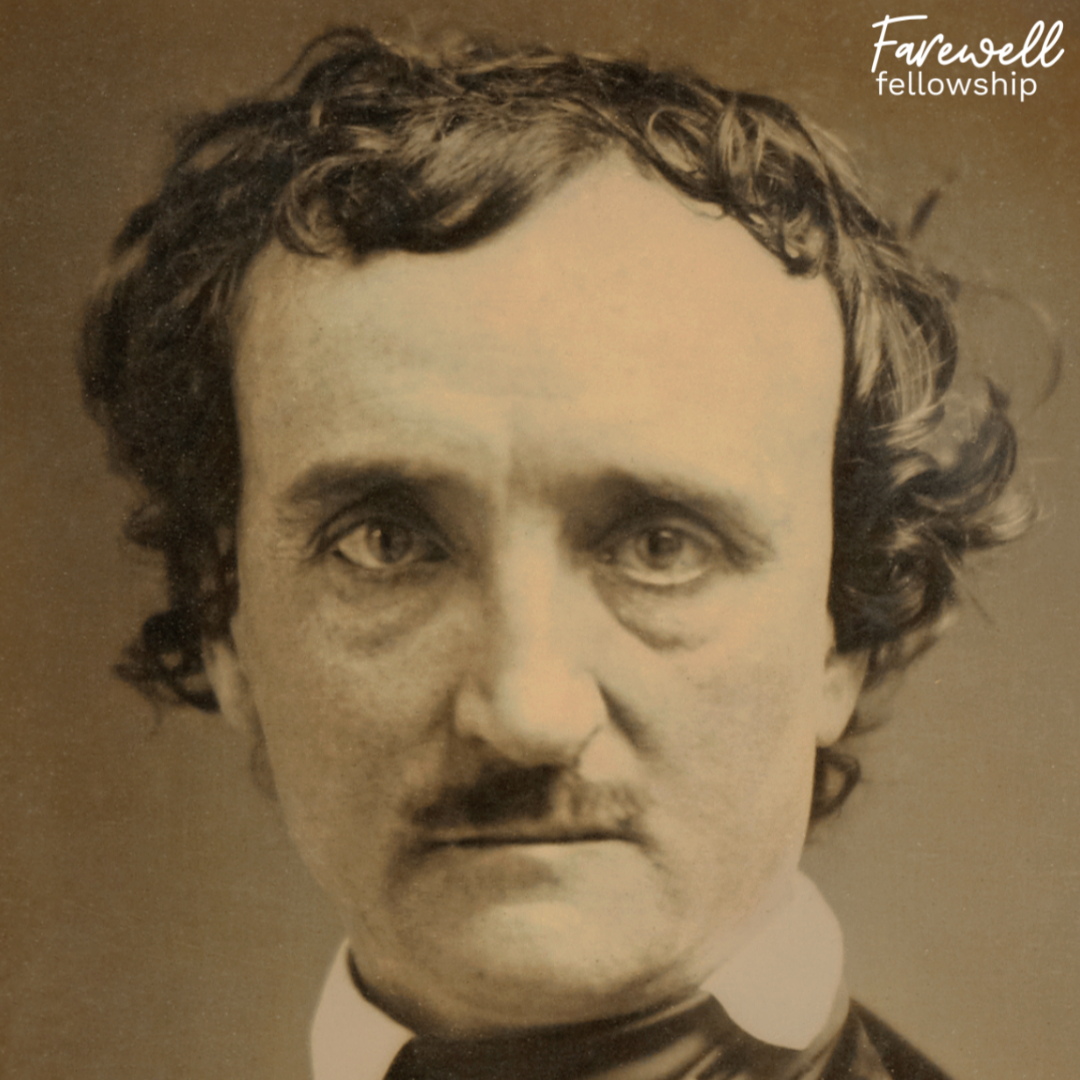
My teenagers are reading Edgar Allan Poe in their high school literature classes right now, which has me thinking about Edgar Allan Poe at 40. What if someone had sat down beside him and told him that nearly two centuries later, teenagers would be assigned his stories in school? Or that people would travel to Baltimore to stand at his grave? That his face would be instantly recognizable, that his poems would be quoted from memory, and that people would still be arguing about how he died? I wonder if he would have believed them. Probably not.
Poe was a well known writer and editor during his lifetime, notorious enough for his vicious literary reviews that he earned the nickname “The Tomahawk Man.” But he also struggled financially, made plenty of enemies, and experienced an extraordinary amount of loss.
At 40, there was no way for him to know that the work he had already put into the world would long outlive him. He didn’t have much more life ahead of him, either; Edgar Allan Poe died at 40, under mysterious circumstances. As we move into creepy season, where the veil is rumored to be thin and we see imagery straight out of his gothic horror novels sprinkling our lawns as decor, I find myself thinking about Poe and his death and his legacy.
Poe’s death was certainly as strange as his life. In fact, there is almost a perfect irony at the way one of the greatest macabre writers in history left this Earth. But what is even more fascinating to me is that we rarely know, while we’re living, what parts of us will remain.
Poe couldn’t have known that my teenagers would be reading him in Tennessee in 2026. He would likely have never guessed that strangers would someday leave roses and cognac at his grave or that people would still pore over the final missing days of his life looking for answers. He likely had no idea that Edgar Allan Poe would become Edgar Allan Poe.
And I can’t stop thinking about that.
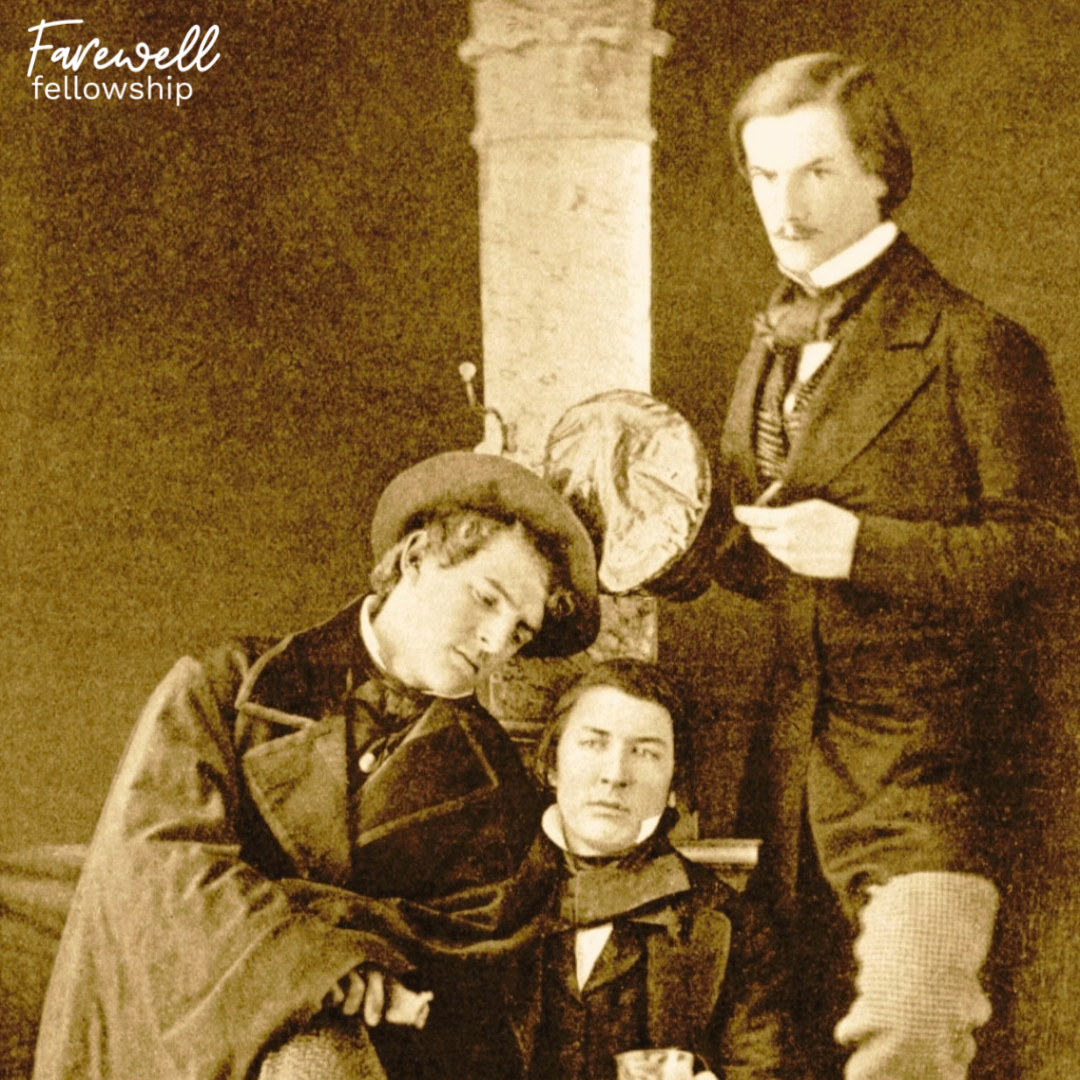
Poe standing on the right with friends from the University of Virginia. Getty Images.
The Deaths That Shaped Him
Before death became one of Poe’s great literary subjects, it was simply part of his life. His father disappeared while Poe was very young. His mother, Eliza, died of tuberculosis before his third birthday. Poe was taken in by John and Frances Allan of Richmond, Virginia. They raised him, though they never formally adopted him, and gave him the middle name by which we know him today.
Frances Allan died when Poe was 20 and Poe’s older brother, Henry, died two years later when he was 24. In 1836, Poe married his cousin Virginia Clemm, when she was 13 and he was 27. Several years later, Virginia developed tuberculosis and her illness lasted for years before she died in 1847 at 24 years old. The same disease that had killed Poe’s mother had now killed his wife and Poe himself would be dead less than three years later.
It would be too easy to turn all of this into a neat explanation for Poe’s writing. Death was much more visible in nineteenth century life than it is for many of us now, and plenty besides personal grief shaped his work. But death is everywhere in Poe: murder, mourning, decomposition, premature burial, bodies hidden beneath floorboards and behind walls, people who may or may not actually be dead, and dead people who refuse to stay gone.
Poe seemed particularly fascinated by the uncertain place where life ends and death begins. In The Premature Burial, he wrote:
“The boundaries which divide Life from Death are at best shadowy and vague.”
Then Poe, with no chronic or diagnosed illness, at age 40, crossed that boundary himself and no one knows exactly how.
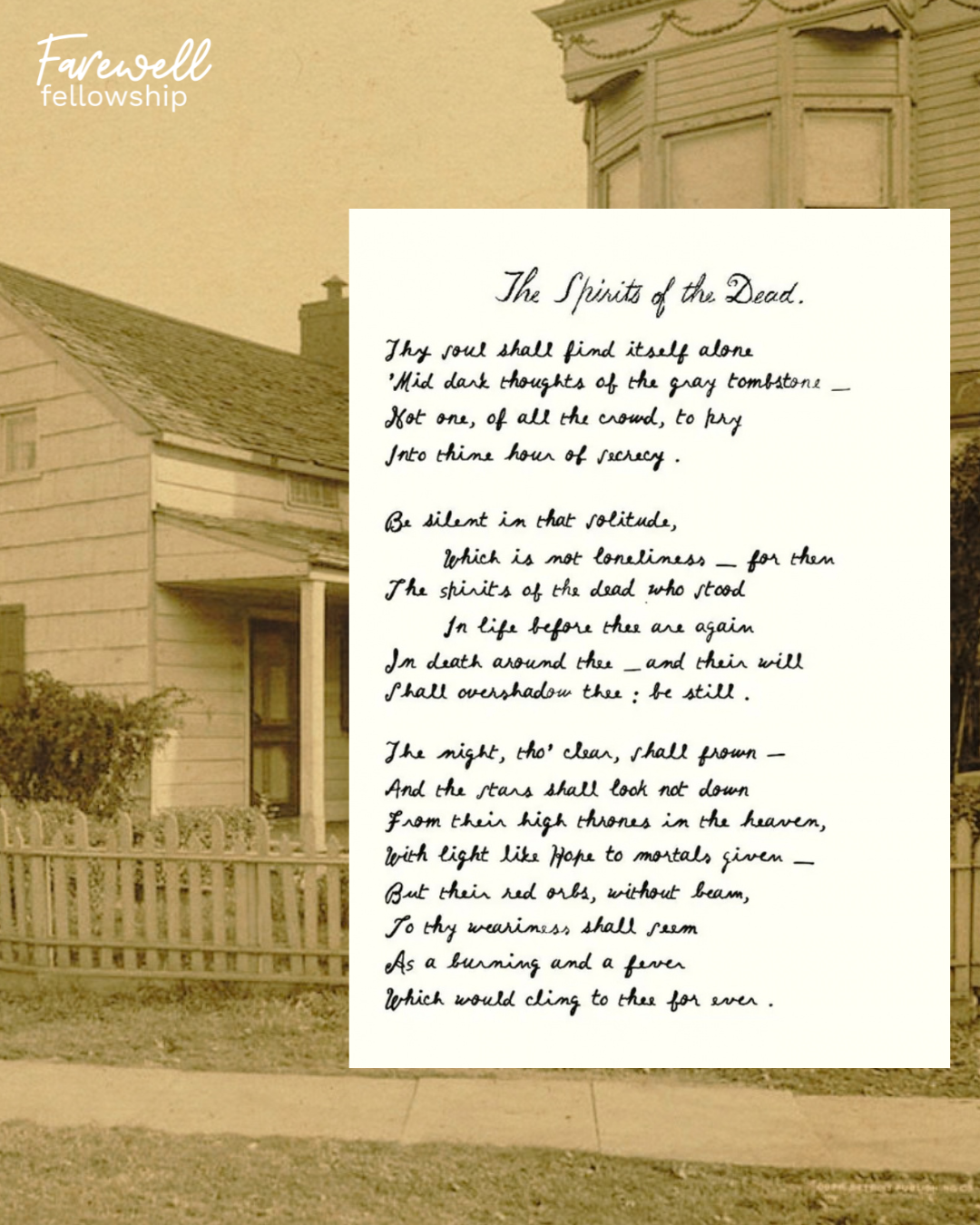
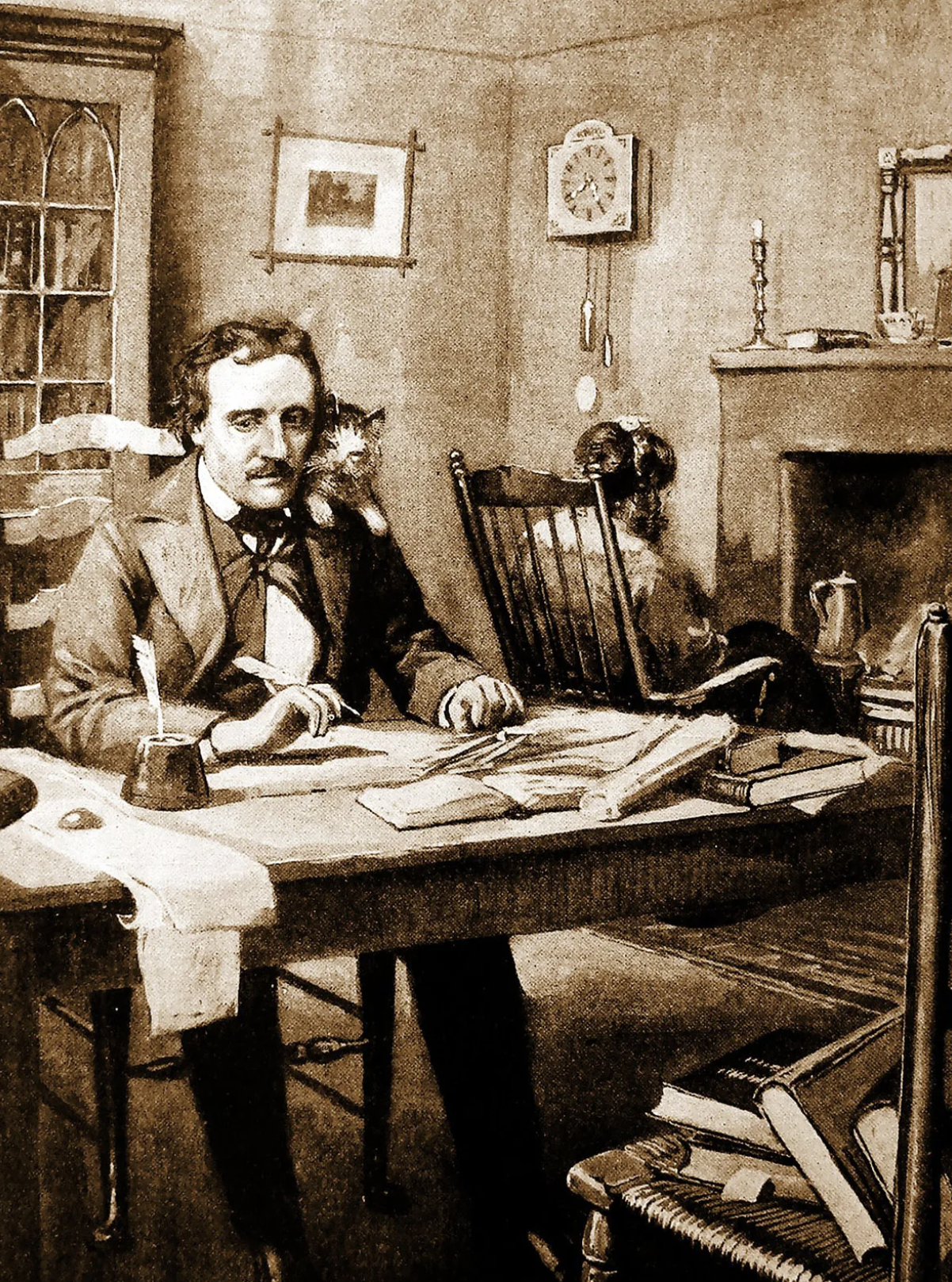
Poe’s writing cottage and a handwritten poem.
The Mystery He Left Behind
On September 27, 1849, Poe left Richmond. He had been deep in the throes of grief following his wife, Virginia’s death but was newly engaged to his childhood sweetheart, the widowed Sarah Elmira Royster Shelton, and was supposedly headed to Philadelphia on literary business. At the end of Poe’s life, he was well-known as a writer. In fact, the famed work “Annabel Lee” was published for the first time just days after his death.
This is important because Poe left Richmond with a life waiting for him: a well paying literary job, a fiancé, plans to go to New York and letters detailing his next steps. As far as he knew, he was going somewhere, but Poe never arrived. For six days, Poe seemingly disappeared.
Then, on October 3, he turned up in Baltimore. Poe was found in great distress outside Gunner’s Hall, a tavern that was being used as a polling place on Election Day. He was delirious and barely able to communicate and he was reportedly wearing cheap, ill fitting clothes that weren’t his.
Although he was taken to Washington College Hospital, he never recovered enough to explain what had happened. According to his attending physician, Poe repeatedly called out one name during his final night: “Reynolds” but no one knows who he meant. Four days after he was found, on October 7, 1849, Edgar Allan Poe died.
His physician later reported his final words as: “Lord, help my poor soul.” He was 40 years old and we still don’t know exactly what killed him. The theories have included alcohol, rabies, meningitis or encephalitis, violence, a brain tumor and various other illnesses.
And then there is “cooping.” Cooping was a form of election fraud in which victims were allegedly kidnapped, drugged or intoxicated, disguised, and forced to vote repeatedly under different identities. Poe was found on Election Day and outside a polling place, wearing someone else’s clothes; it makes for an irresistible theory but we just don’t know if it’s true.
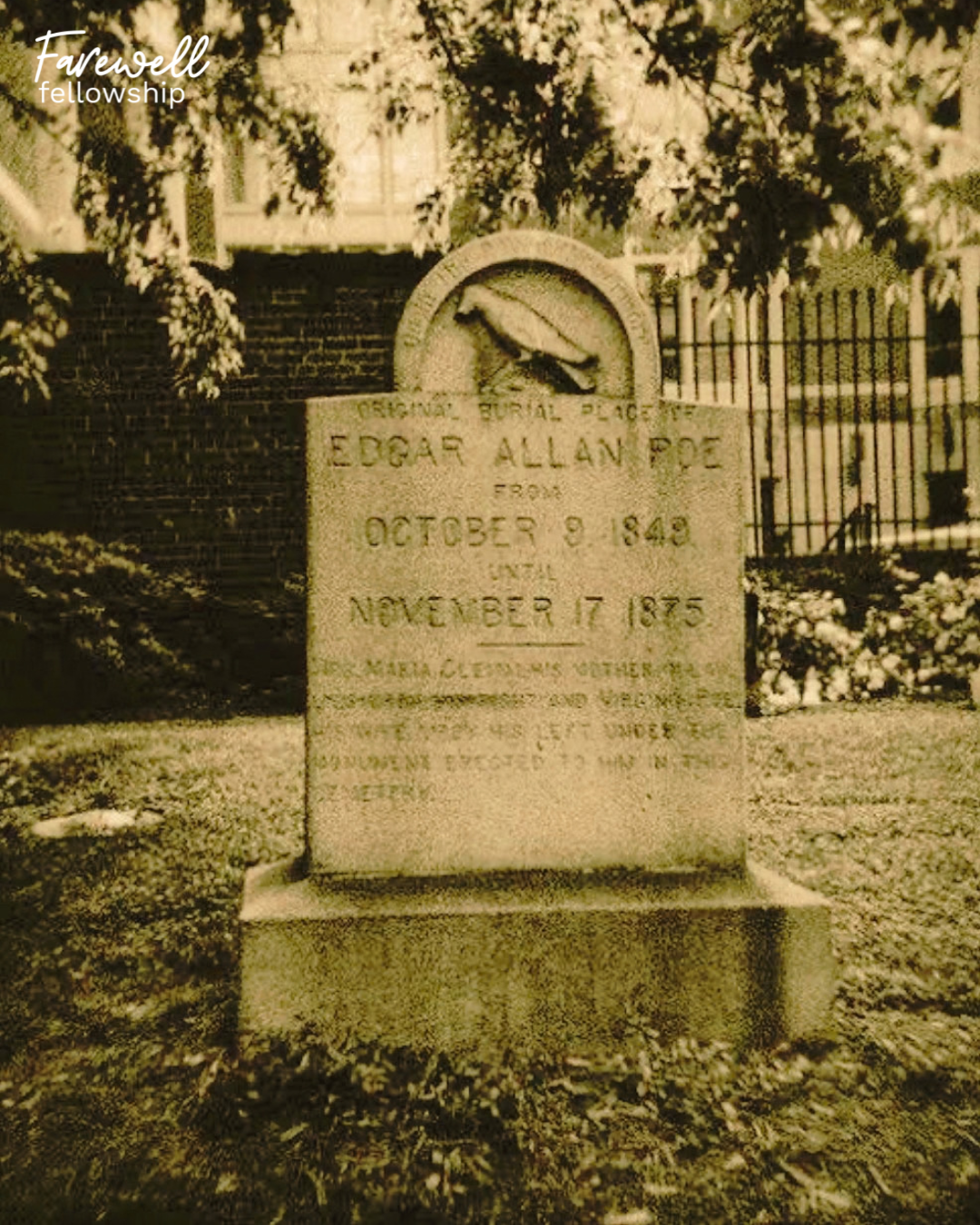
Because this is Edgar Allan Poe, the story somehow gets stranger after his death. Poe was buried in the family plot at Westminster Presbyterian Burying Ground in Baltimore after a humble funeral. Twenty six years later, his remains were exhumed so they could be moved to a place of honor near the entrance of the cemetery.
As expected, his coffin had deteriorated badly and during the exhumation, it broke apart. Witnesses reported something hard rolling around inside Poe’s skull. Newspapers of the time claimed it was his brain but it almost certainly wasn’t; brain tissue should have decomposed long before. One later theory suggested the object could have been a calcified brain tumor.
Even Poe’s body left behind a mystery.
What Remains
Of course, Poe didn’t get to decide what happened to his story after October 7, 1849, other people did. One of his literary rivals, Rufus Wilmot Griswold, published a vicious obituary under a pseudonym shortly after Poe died.
“Edgar Allan Poe is dead. He died in Baltimore the day before yesterday. This announcement will startle many, but few will be grieved by it.”
Griswold later wrote a biographical account portraying Poe as unstable, immoral and self destructive. As is true for much of what we say of the dead, some of his claims were distorted and some were purely false but it didn’t matter, they became part of the story all the same.
But so did Poe’s own words. And over time, those words proved considerably harder to kill. People kept reading him. They published him and republished him. They memorized The Raven. They taught The Tell-Tale Heart in classrooms. They built a monument over his grave.
And eventually, someone started bringing him cognac. For decades, an unidentified visitor appeared at Poe’s grave around his January birthday, dressed in black, to leave three roses and a bottle of cognac. They became known as the Poe Toaster and no one ever definitively identified the original visitor.
I love that. Not because it’s spooky, although it certainly is. I love it because bringing something to the dead is one of the oldest and most ordinary things humans do: we visit, we bring flowers to honor, we leave food and drink, we say their names, we tell their stories, we keep them with us in whatever ways we know how. And sometimes the thing someone leaves behind travels much farther than they ever could have imagined.
Somehow today, my teenagers are sitting in a classroom 700 miles from where Poe is buried, reading words he wrote almost 177 years ago. He never knew them but they know his name. There is something about that I find enormously comforting.
We don’t get to know which parts of us will remain. We don’t get to control every story told about us after we’re gone. We might not even recognize the version of ourselves that survives. We just get this part, the living of it.
We make things. We love people. We write things down. We teach something. We make someone laugh. We give things away. We leave impressions on people we may not even realize we’ve touched. We put whatever we have into the world. And then, eventually, we leave it here.
The rest belongs to the people who remember us.
Jade Adgate is a death doula, educator, and advocate. Through her work at Farewell Fellowship, Farewell Education, and Farewell Library, she guides others in exploring mortality and cultivating understanding, reflection, wonder and care around life and death.