
8 Books That Changed How I Think About Death, Dying & Deathwork

When I first started doing deathwork, I read books because I wanted answers.
I wanted to understand what happens to the body as it dies. I wanted to know what to say when someone was afraid. I wanted to understand hospice and advance directives and grief and vigils and funerals. I wanted to know what families needed from me and how to give it to them.
I read the books you would expect a new death doula to read. I took trainings. I learned the signs and symptoms. I learned the systems. Eventually, I became the person teaching those things to other people.
And of course, some of that knowledge matters enormously.
But after years of sitting with dying people and their families, I’ve realized that many of the books that have shaped my deathwork most profoundly aren’t really about death at all.
They’re about bodies and power. Spirituality and ritual. Reciprocity and community. Medicine and professionalization. Mysticism, service, race, gender, and the ways we decide whose knowledge counts.
Rather than giving me answers, these books disrupted something I thought I knew.
They taught me to ask better questions.
Maybe that is part of what happens when you spend enough time around death. You become increasingly aware of the limits of what can be known.
You can know every physical sign of active dying and still not know whether someone has hours or days. You can understand grief theory and have absolutely no idea what to say to the person whose child just died. You can know everything medicine can tell you about what is happening inside someone’s body and still know very little about what is happening to them.
And you can spend years beside dying people and still have no definitive answer to the biggest question of all:
What happens next?
Over time, deathwork has made me more comfortable there. In uncertainty. In mystery. In the possibility that knowing isn’t always the point.
These are eight books that have helped me stay there, and the questions they have left me carrying.
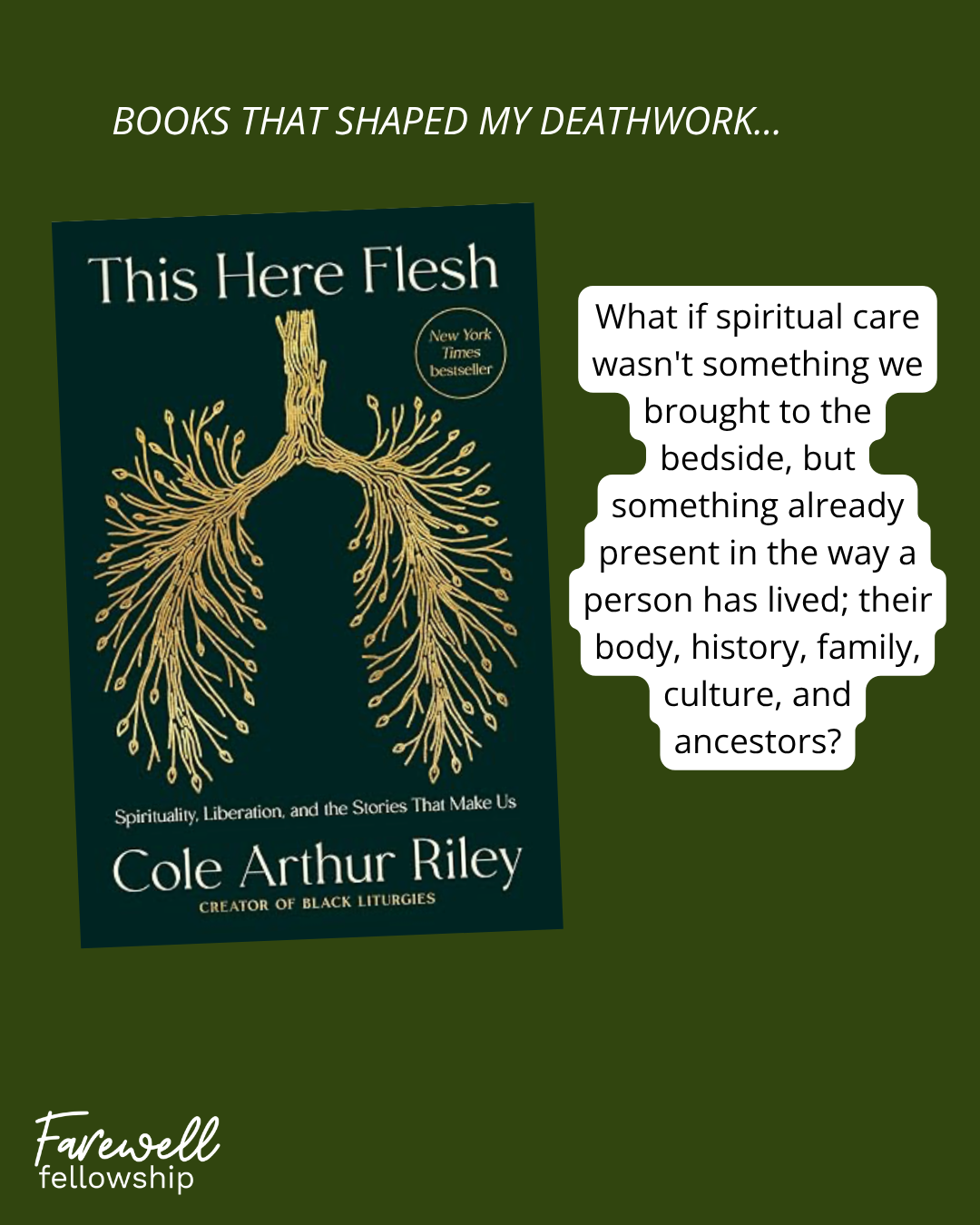
1. This Here Flesh by Cole Arthur Riley
What if spiritual care wasn't something we brought to the bedside, but something already present in the way a person has lived: their body, history, family, culture, and ancestors?
Cole Arthur Riley writes about dignity, belonging, lament, memory, rest, liberation, and the body, particularly the Black body. Her work has made me think about what it means to recognize the body itself as a place where knowledge, history, culture, and spirituality reside.
That feels particularly important at the end of life.
We live in a culture that often treats the body as something to manage. We discipline it, improve it, diagnose it, optimize it. When it becomes sick or old or disabled, we can begin speaking about it as though it has betrayed us.
But dying makes the body increasingly difficult to ignore.
The body communicates even when words disappear. A hand relaxes. Breathing changes. Someone turns toward a familiar voice. A person who hasn’t eaten in days closes their mouth against another spoonful.
There is information there.
And there is an entire life already present at the bedside before any practitioner enters the room: family, culture, ancestry, memory, faith, doubt, food, music, language, place.
This Here Flesh has made me wonder what changes when spiritual care begins there rather than with whatever we think we should bring into the room.
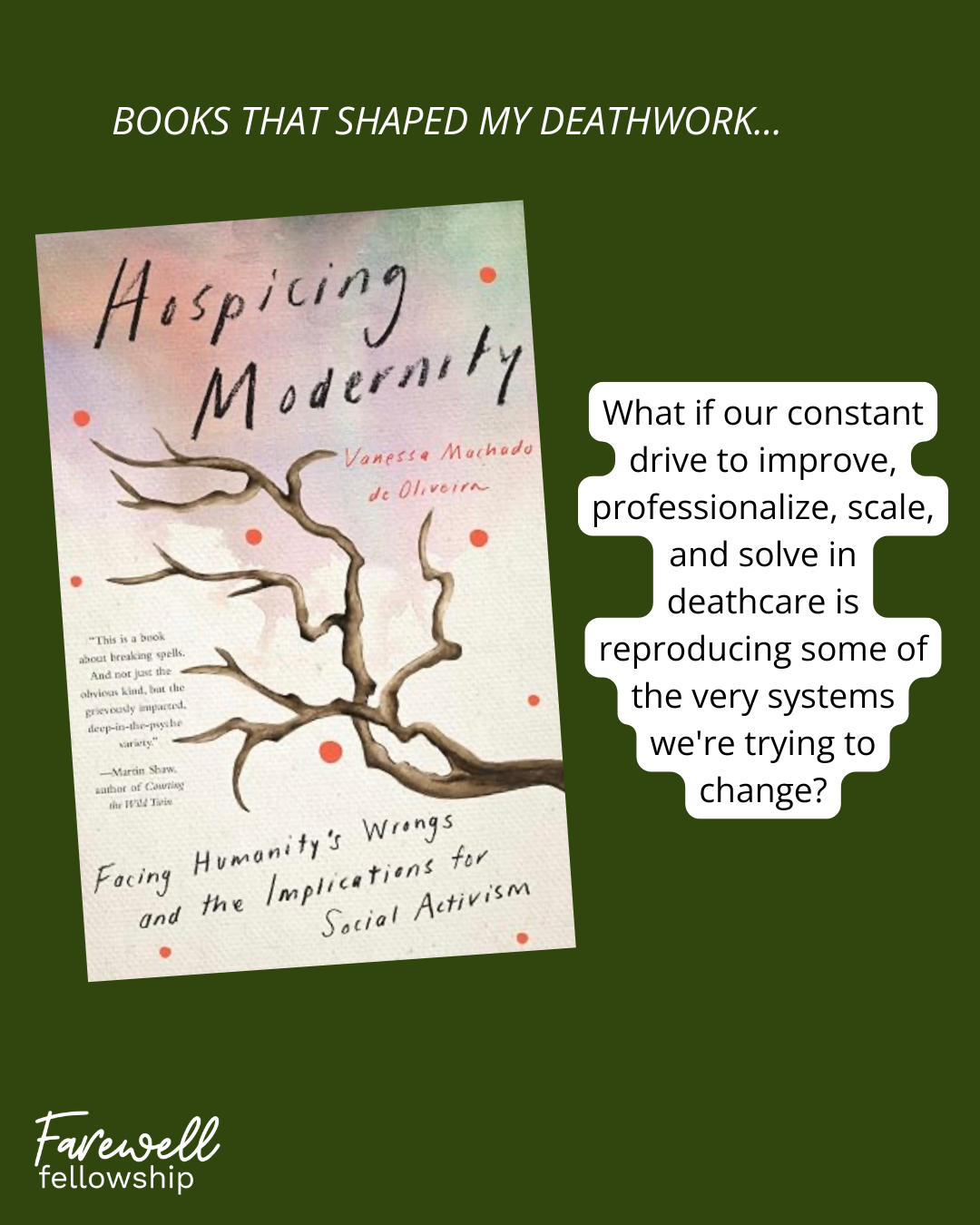
2. Hospicing Modernity by Vanessa Machado de Oliveira
What if our constant drive to improve, professionalize, scale, and solve in deathcare is reproducing some of the very systems we're trying to change?
Hospicing Modernity isn’t really a book about deathcare. Vanessa Machado de Oliveira uses hospicing as a much larger metaphor, asking what it might mean to recognize that many of the dominant systems and ways of thinking we have inherited are unsustainable without immediately trying to replace them with another solution built from the same assumptions.
That question has stayed with me.
We are very good at identifying something that isn’t working and immediately asking what we should build instead.
How do we improve it? Organize it? Measure it? Professionalize it? Scale it?
I think about this in deathcare.
The death positive movement has spent years naming what was lost as dying moved increasingly into institutions and professional hands. We talk about returning death to communities, restoring family participation, reclaiming ritual, and remembering knowledge that once moved between generations.
And then we can turn around and professionalize the reclamation.
That contradiction has made me increasingly suspicious of my own instinct to respond to every problem by building something better.
What if some things need to be allowed to end before we decide what replaces them?
And what are we unknowingly carrying forward when we rush to build the next thing?
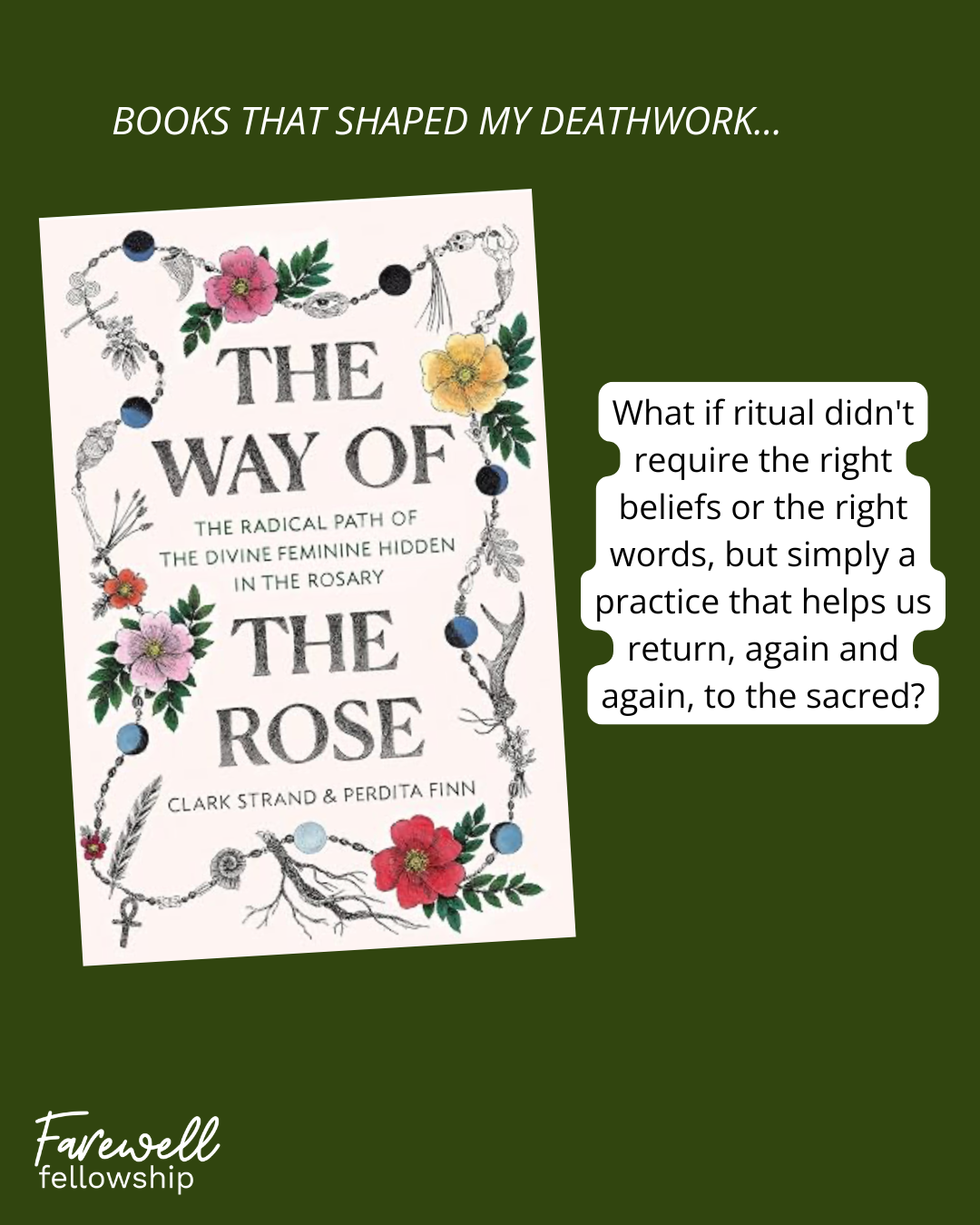
3. The Way of the Rose by Clark Strand and Perdita Finn
What if ritual didn't require the right beliefs or the right words, but simply a practice that helps us return, again and again, to the sacred?
I was reading recently about metaphor as the voice of God. The author encouraged the reader to picture a feeling of safety and then look for the metaphor waiting there.
For me, safety is sitting in the pew of St. Maurice Church, tucked into the eaves of my grandmother’s body.
My relationship with the church is complicated now. There are beliefs I no longer hold, institutions I don’t trust, and wounds I don’t need to reconcile in order to acknowledge them.
For a long time, I think I assumed leaving those things meant leaving all of it.
The Way of the Rose offered me another possibility.
Maybe I don’t have to choose between the church and the grandmother.
Maybe I am allowed to let the matriarch offer safety under the roof of the church.
Can I keep the ritual without accepting all the dogma? Can I say an old prayer because the words connect me to the women who said it before me without needing to resolve exactly what I believe about every word? Can we grieve what hurt us while reclaiming what was beautiful?
Death has a way of calling old traditions back into the room.
I find myself wondering whether we ever needed to abandon them entirely in the first place.
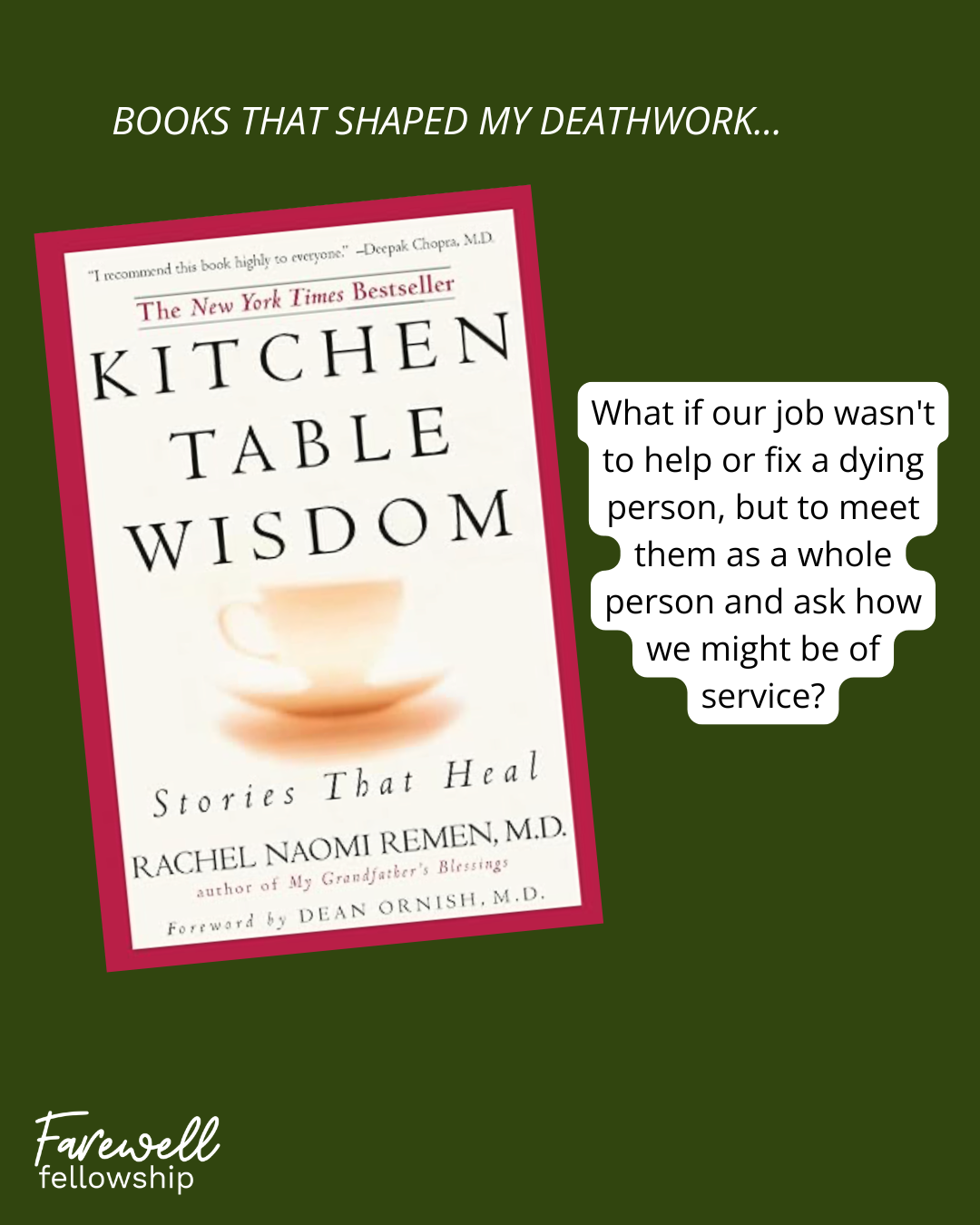
4. Kitchen Table Wisdom by Rachel Naomi Remen
What if our job wasn't to help or fix a dying person, but to meet them as a whole person and ask how we might be of service?
Rachel Naomi Remen’s distinction between fixing, helping, and serving fundamentally changed how I understand care.
Fixing begins with the assumption that something is broken. Helping can create a relationship between someone who has something to give and someone who needs it. Service asks something different of us. It asks us to encounter another person in their wholeness.
That distinction matters enormously in deathwork.
When someone is dying, illness can quickly become the organizing principle of their existence. Their days become appointments, medications, symptoms, oxygen levels, pain scores, intake and output. Everyone entering the room has something to assess, manage, treat, document, or improve.
Even those of us working outside the medical system can arrive with our own ideas about what would make things better.
But the person in the bed is still a whole person.
They had a life before we entered the room. They have preferences and contradictions, relationships and regrets, humor and irritation, memories and private ways of making meaning.
Remen’s work has left me wondering how differently we might care for dying people if we stopped beginning with what they need from us and instead began by asking who they are.
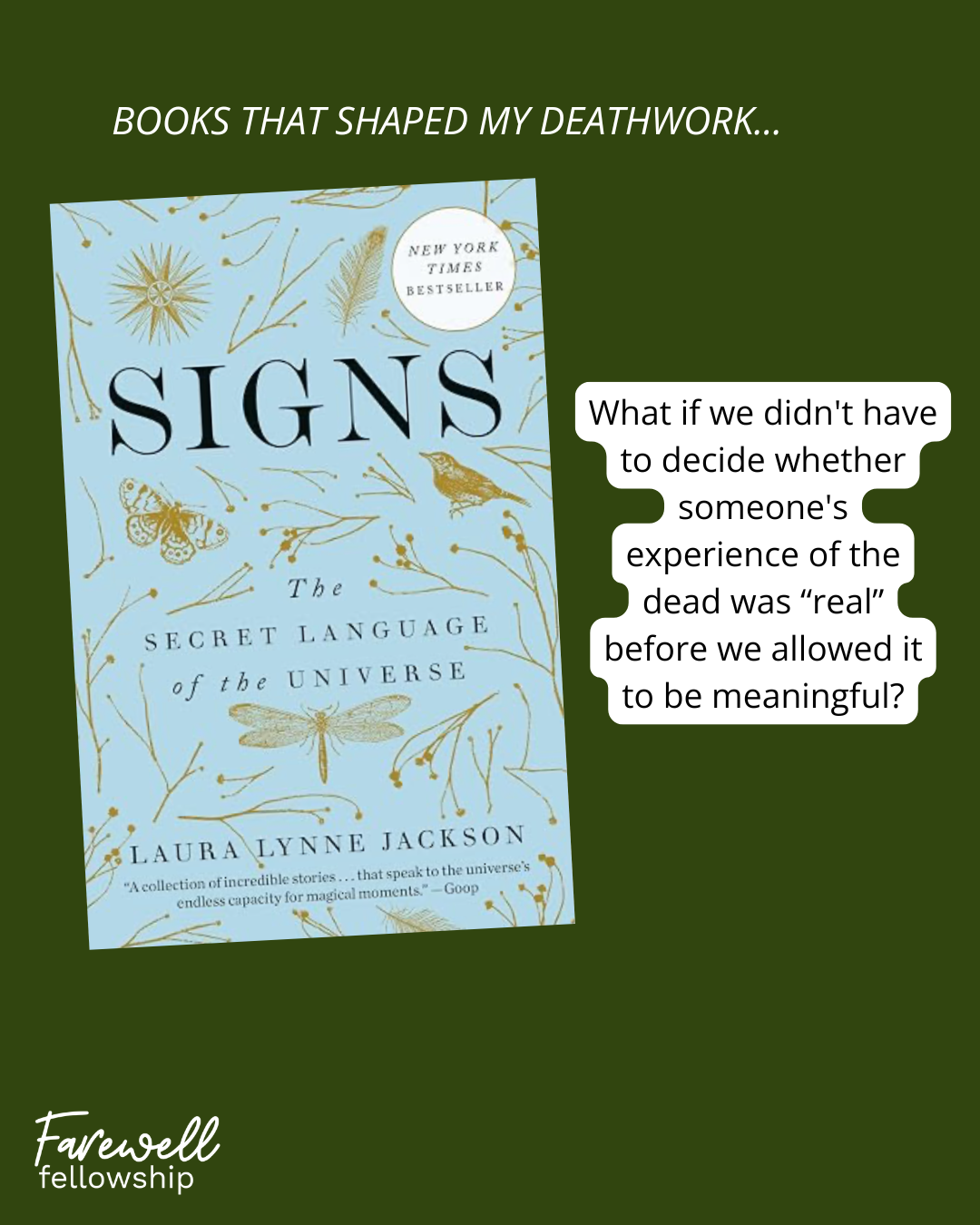
5. Signs by Laura Lynne Jackson
What if we didn't have to decide whether someone's experience of the dead was “real” before we allowed it to be meaningful?
Not long ago, I attended the funeral of a client I had cared for at the end of her life. At the graveside, her adult daughters read Henry Scott Holland’s Death Is Nothing at All, the passage that opens Signs.
I knew it immediately.
I stood there listening to my client’s daughters read those words over their mother’s grave and thought about how often I speak to the dead.
I do it constantly.
Sometimes I speak aloud. Sometimes I ask someone who has died to send me something. Sometimes a song comes on at precisely the right moment, or an animal appears, or something happens that is so strangely specific that I know exactly who I associate it with. I have dreams that feel different from other dreams. I have moments when someone who is dead feels very close.
Do I know that any of those things are actually messages from the dead?
No.
But I’ve become increasingly uninterested in answering that question.
Signs has made me wonder why we are so quick to demand that these experiences declare themselves either real or not real before we are willing to receive what they offer.
Why does meaning require proof?
And what might happen if, instead of asking whether the dead are really speaking, we simply listened?
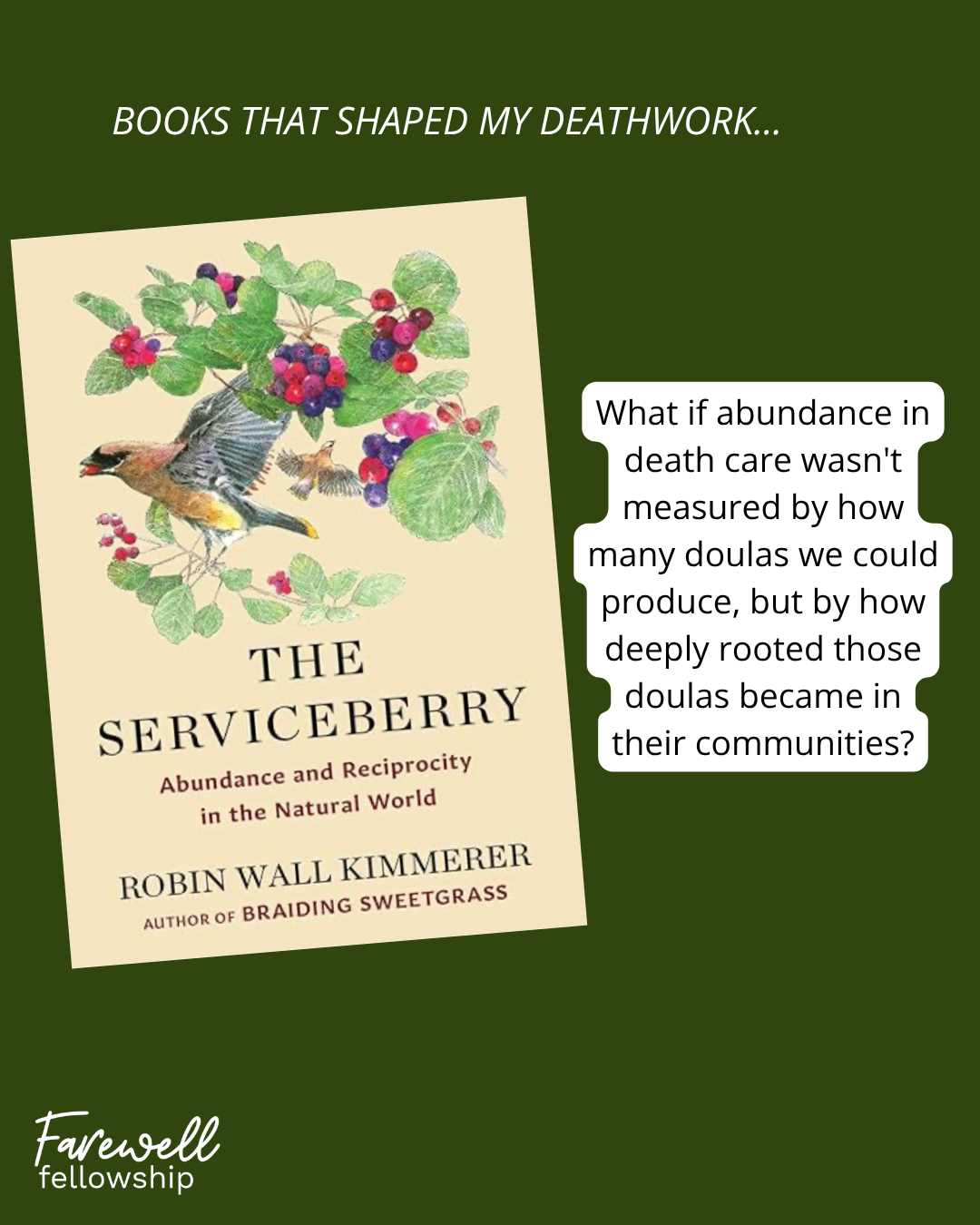
6. The Serviceberry by Robin Wall Kimmerer
What if abundance in death care wasn't measured by how many doulas we could produce, but by how deeply rooted those doulas became in their communities?
Recently, I opened a newsletter from a popular death doula trainer who wrote that she hoped one day she would have to close her doors because she had succeeded in teaching everyone how to be a death doula.
I understood the sentiment, but I immediately thought of The Serviceberry.
Why would one teacher need to teach everyone?
Robin Wall Kimmerer writes about abundance through the serviceberry, a plant that gives generously within an ecosystem of relationships. Her writing has had me questioning how easily our ideas about abundance become entangled with expansion.
Even when our intentions are generous, we can still imagine success as extending our own reach farther and farther outward.
What if the success of a death doula training program was measured differently?
What if it was measured by how deeply rooted each graduate became in their own community?
What if we encouraged the people we had already taught to turn toward the people around them, to teach families how to care for their dying, share what they know with neighbors and faith communities, and eventually become teachers themselves?
What if my responsibility isn’t to keep expanding the boundaries of my own territory, but to tend the patch of ground already beneath my feet?
The Serviceberry has made me wonder whether abundance in deathwork might look less like an ever expanding field and more like a healthy ecosystem: knowledge moving outward through relationship, each person tending their own patch, each new growth eventually producing something it can give away.
What if the goal isn’t for me to teach everyone?
What if the goal is to teach in a way that means I don’t have to?
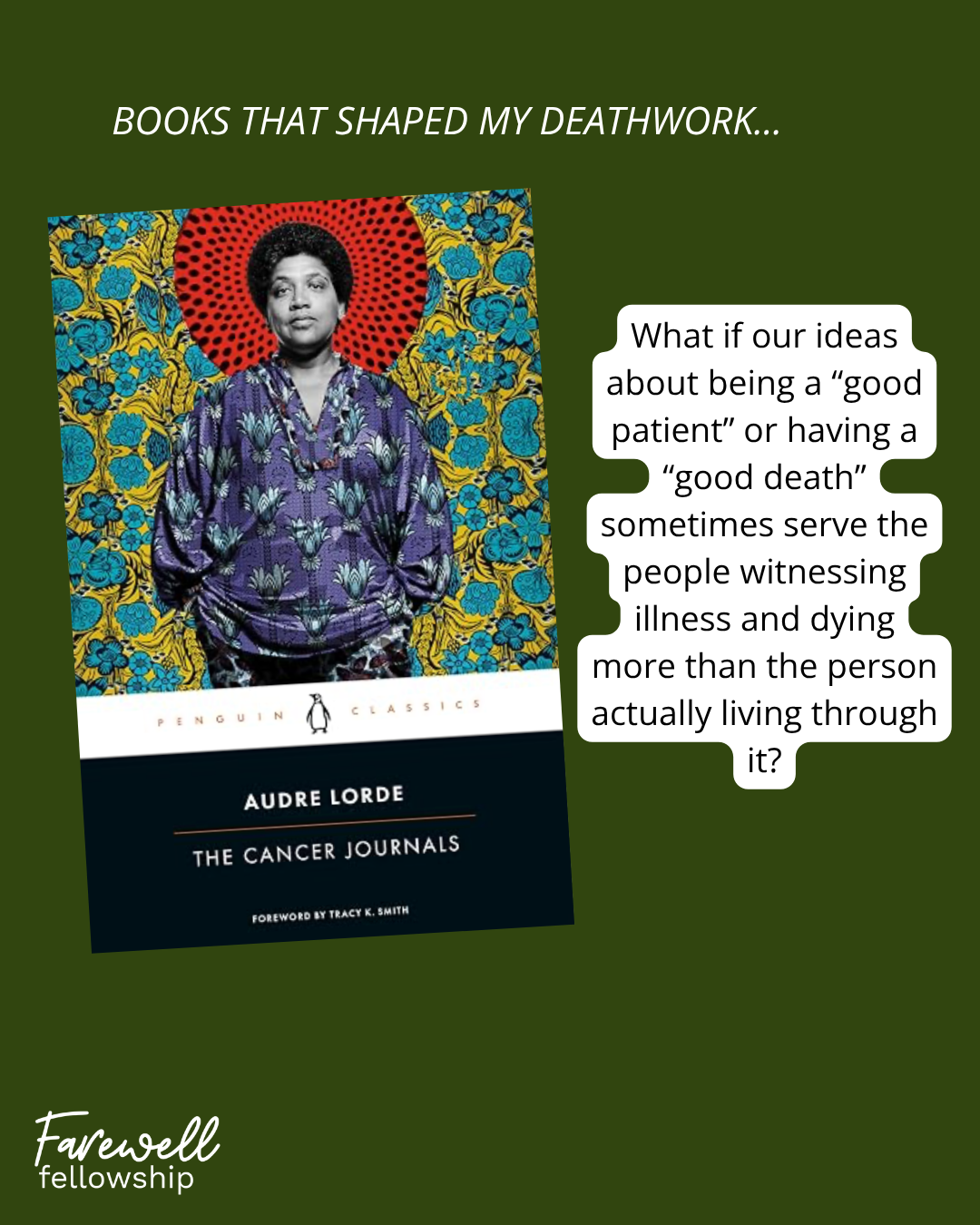
7. The Cancer Journals by Audre Lorde
What if our ideas about being a “good patient” or having a “good death” sometimes serve the people witnessing illness and dying more than the person actually living through it?
Audre Lorde did not write The Cancer Journals to make breast cancer easier for anyone else to look at.
She wrote candidly about fear, anger, mastectomy, sexuality, identity, and living in a body permanently changed by illness. She resisted expectations that women should conceal those changes to make their bodies appear more acceptable or familiar.
I think about that when we talk about a “good death.”
We have our own expectations.
Be peaceful. Accept what is happening. Make meaning. Repair your relationships. Say the important things. Choose comfort. Let go.
There can be enormous beauty in all of those things.
But Lorde makes me wonder about the expectations hidden inside them.
What happens when the dying person isn’t peaceful? What if they are angry? What if they don’t want to talk about death? What if they don’t want to reconcile? What if they aren’t interested in finding meaning in what is happening to them?
How much of what we call acceptance is something we need from the dying person because their resistance makes usuncomfortable?
And what if a good death isn’t something we can define from the outside at all?
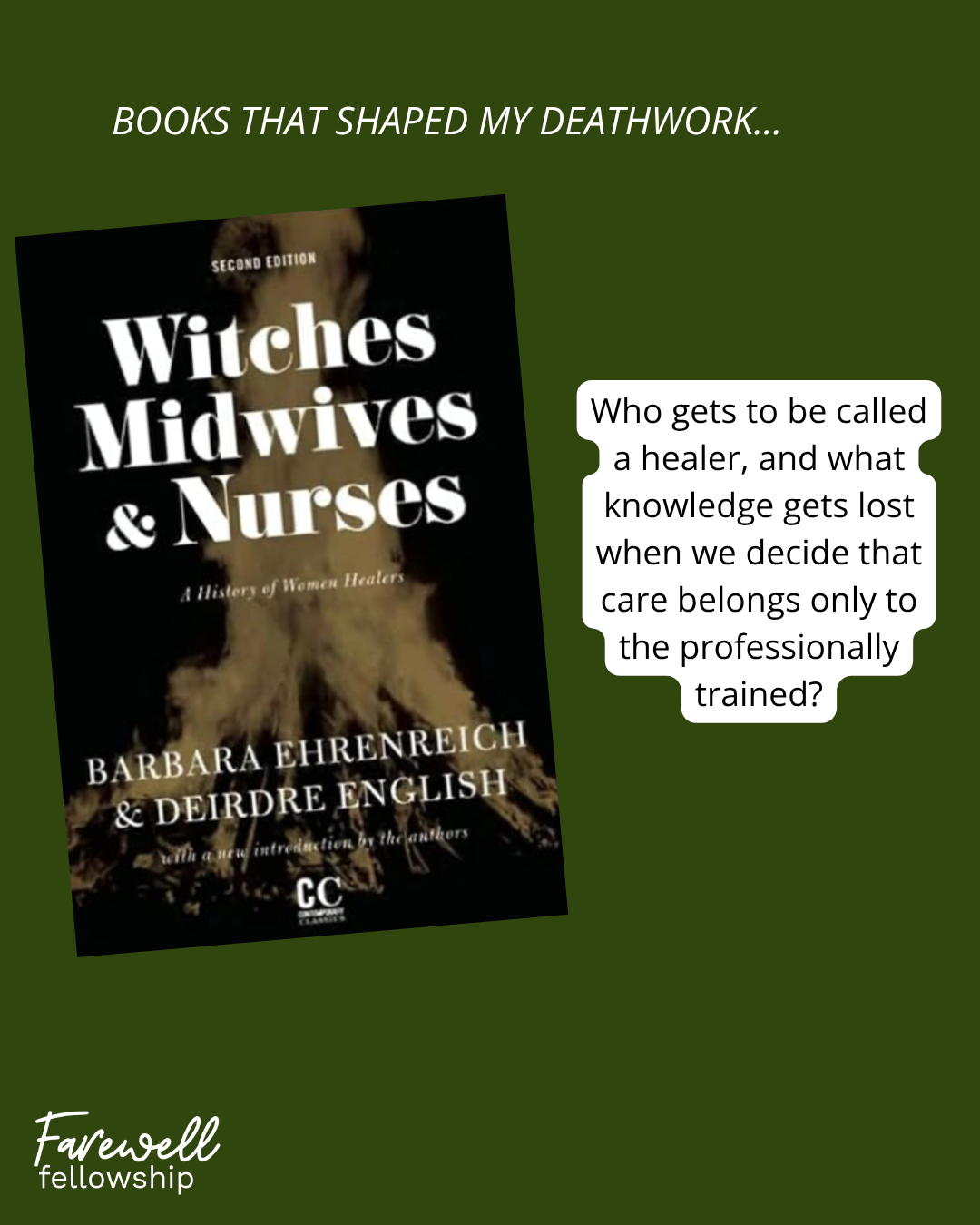
8. Witches, Midwives & Nurses by Barbara Ehrenreich and Deirdre English
Who gets to be called a healer, and what knowledge gets lost when we decide that care belongs only to the professionally trained?
I have spent much of my career trying to make death doula work legitimate.
I’ve taught curricula, developed standards, created certificates, talked about scope of practice, and tried to articulate what someone should know before they begin accompanying dying people.
Witches, Midwives & Nurses makes me question some of that impulse.
Ehrenreich and English examine the history of women as healers and the transfer of authority over healing into an increasingly professionalized medical establishment. Reading it made me think less about whether death doulas deserve a place alongside professional care and more about what happens when we begin using professionalism itself as the measure of legitimacy.
Because caring for the dying did not begin as a profession.
People learned because someone they loved was dying. They watched someone else wash a body. They sat beside beds. They prepared food, kept vigil, prayed, told stories, buried their dead, and passed what they learned to someone else.
Now we can take a course in many of those things.
I teach some of those courses.
And I find myself wondering where the line is between returning knowledge to people and inadvertently positioning ourselves as the people who have permission to give it back.
When we create certifications, standards, and increasingly formal definitions of what makes someone qualified to do this work, what are we protecting?
And what might we be taking away?
Who gets to decide that one kind of knowledge counts while another does not?
Maybe the question isn’t whether death doulas can become legitimate enough to earn a place within our professional systems.
Maybe the more interesting question is why we have learned to believe professional recognition is what makes care legitimate in the first place.
The Fewer Answers I Have
When I first began this work, I thought expertise would feel like certainty.
I thought that with enough years at the bedside, enough books, enough training, and enough people dying in front of me, I would eventually know what good deathwork looked like.
And I do know more than I did then.
But the longer I do this work, the less interested I am in certainty.
These books haven’t given me a better definition of good deathwork. They’ve made me question many of the definitions I once had.
Who gets to be the expert? What counts as knowledge? What belongs to the professional and what belongs to the community? When does helping become fixing? When does growth become expansion for its own sake? How much of what we call a good death is really about making death easier for the rest of us to witness? What do we lose when we discard old traditions because we no longer believe everything that came with them? How much mystery can we allow to remain mysterious?
I don’t know.
I think I used to experience that as a gap I needed to fill.
Now I wonder if learning to stay there is part of the work.
Maybe expertise isn’t only knowing what to do. Maybe it is knowing when your knowledge has reached its edge. Knowing when to become curious instead of certain. Knowing when the person in front of you knows something you don’t. Knowing when a family already carries the wisdom you’re preparing to offer them. Knowing when the question deserves more room than the answer.
The books that have shaped my deathwork most deeply haven’t necessarily taught me how to care for the dying.
They’ve changed the questions I bring with me when I walk into the room.
And after all these years, I think I trust a good question more than I ever trusted an answer.