
The Correspondent by Virginia Evans
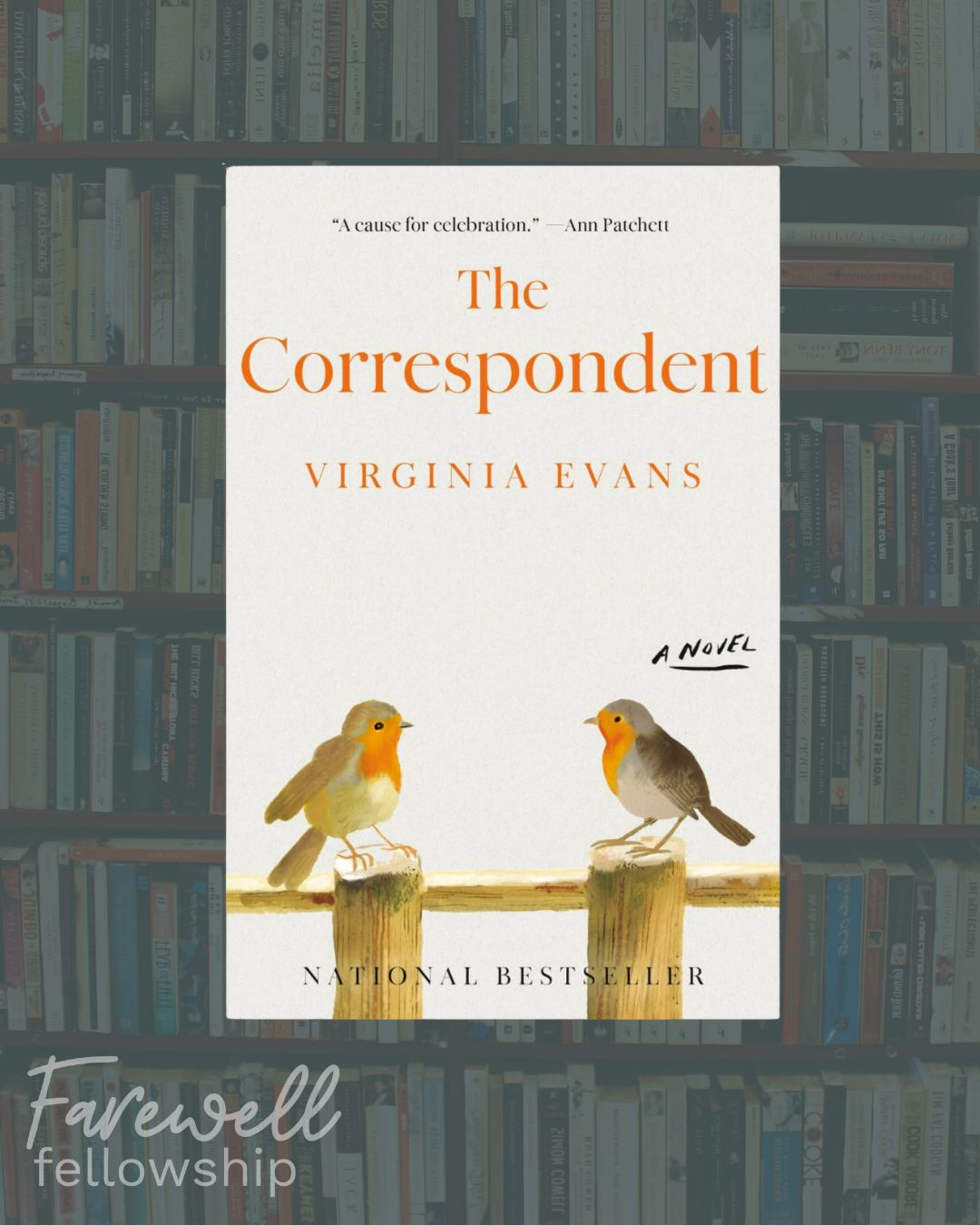
Virginia Evans’ The Correspondent (2024) is an epistolary novel told through letters written by Sybil van Antwerp, a retired lawyer in her last season of life. Sybil is complex and multi-faceted character who is richly layered with contradictions: she loves deeply but can be callous, she is generous with her time but severe with her tone, she is funny and wise but startlingly immature at times. All in all, Sybil as a character is as flawed and fabulous as a person.
What begins as simple correspondence, a habit of Sybil’s life that she has continued in her retirement years, slowly opens into something much larger: an interior world shaped by grief, memory, love, and the ever-present human condition of change. Through Sybil’s letters, we are invited into a life that is not being neatly summarized at its end, but actively re-examined, questioned, and re-imagined in real time.
As a death doula (and a lifelong reader who uses literature to deepen my fluency around death and grief), this is exactly the kind of book I look for and recommend. There are moments in my work where language alone cannot fully hold the experience of grief, aging or dying. Books like this help bridge that gap. They offer readers a way in, a shared vocabulary for what is often unspeakable, or at least difficult to articulate.
The Correspondent functions like that kind of threshold text. It doesn’t define grief from a distance; it sits inside it. It lets meaning emerge slowly, through fragments, pauses, and return. That, to me, is one of the most compassionate things a book can do.
A life in correspondence
One of the most striking elements of the novel is Sybil’s practice of writing letters not only to people she knows, but also to figures she does not; George Lucas, Ann Patchett, Joan Didion among them. What could feel whimsical instead becomes something tender and revealing: a reminder that we are always in relationship, even across distance, time, and imagination.
And remarkably, some of them write back.
That exchange (real or imagined, literal or symbolic) creates a porousness between Sybil’s inner life and the wider world. It underscores one of the book’s central themes: that meaning is often made in dialogue, even when the conversation is uneven, delayed, or entirely internal.
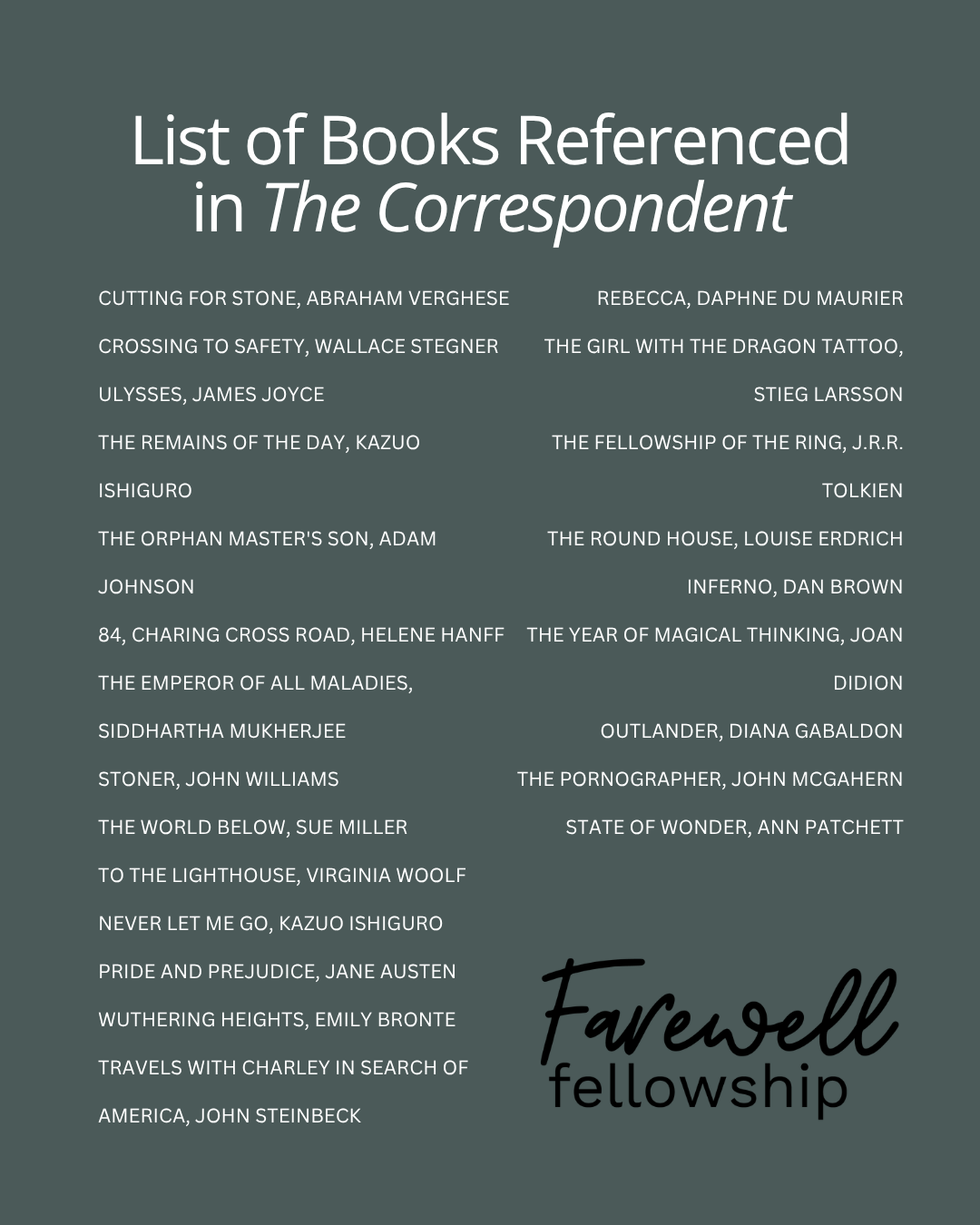
I also loved how many books live inside this book. Reading The Correspondent became its own kind of literary mapping. I found myself keeping a running list of titles as I went, texts that shaped Sybil’s thinking, memory, and imagination. It felt like being invited into a second reading life alongside her. Consider this your invitation to do the same.
Relationship continues
One of the things I return to again and again in end-of-life work is the idea that relationship does not end cleanly at death or even near it. It shifts, transforms, and continues in new forms: memory, story, imagination, unfinished conversation.
Sybil’s letters embody this beautifully. She is not only writing to others; she is still in relationship with them. Even absence becomes conversational. This reflects something I see often in grief: that connection does not disappear, it changes shape.
Aging as becoming, not just ending
What stayed with me most is how Sybil is portrayed, not as someone simply approaching the end of life, but as someone still actively becoming within it.
She is grieving, yes. But she is also healing. She is falling in love. And also out of it. She is revisiting choices and reinterpreting old narratives just as she forges new paths and steps outside of her comfort zone. Sybil is (though elder) a dynamic character living and is still making meaning. The novel refuses the cultural flattening of aging as only decline. Instead, it offers something more honest and expansive: aging as complexity, contradiction, and continued transformation.
In Sybil, we see that personhood does not narrow as life progresses, it can deepen, widen, and surprise us.
Grief in its layered forms
One of the most honest gifts of this novel is its refusal to simplify grief into a single emotional arc. Instead, it presents grief as layered, overlapping, evolving and ongoing.
We see grief in:
the loss of a child
the death of someone from the past whose absence still echoes
the quiet grief of a declining body
the grief of the self one once imagined becoming
an immigrant surrendering his profession to start anew
the weight of caregiving
the estrangement from your loved ones
the betrayal of an intimate relationship
None of this grief is linear and none of it is resolved. It coexists, sometimes contradicts itself, and often arrives in unexpected moments. It is messy and tender and real, just as I prefer it in fiction, and just as I witness it in life.
In death care spaces, there is often pressure (cultural and internal) to “resolve” grief. To move it toward completion or closure. But most grief does not behave that way.
What I value about The Correspondent is that it refuses that impulse entirely. It allows grief to remain layered and active. It honors the reality that multiple griefs can exist at once, and that none of them require neat endings to be meaningful. There is no hierarchy to these griefs but they do blend and merge and impact one another with their nuance. This is closer to the truth of what I see in practice: grief is not a problem to solve, but a landscape we learn to live within.
Why this book matters
Books like The Correspondent matter because they give shape to experiences that often resist language. They slow us down. They invite reflection rather than resolution. They remind us that grief is not something we “get through” so much as something we learn to live alongside.
If you are someone who wants to deepen your relationship to grief, aging, memory, or what it means to continue living while holding loss, this is a book worth your time.
It does not offer answers. Instead, it offers companionship. And sometimes, that is exactly what we need.
Jade Adgate is a death doula, educator, and advocate. Through her work at Farewell Fellowship, Farewell Education, and Farewell Library, she guides others in exploring mortality and cultivating understanding, reflection, wonder and care around life and death.