
Ralph Waldo Emerson Opened His Dead Wife’s Coffin
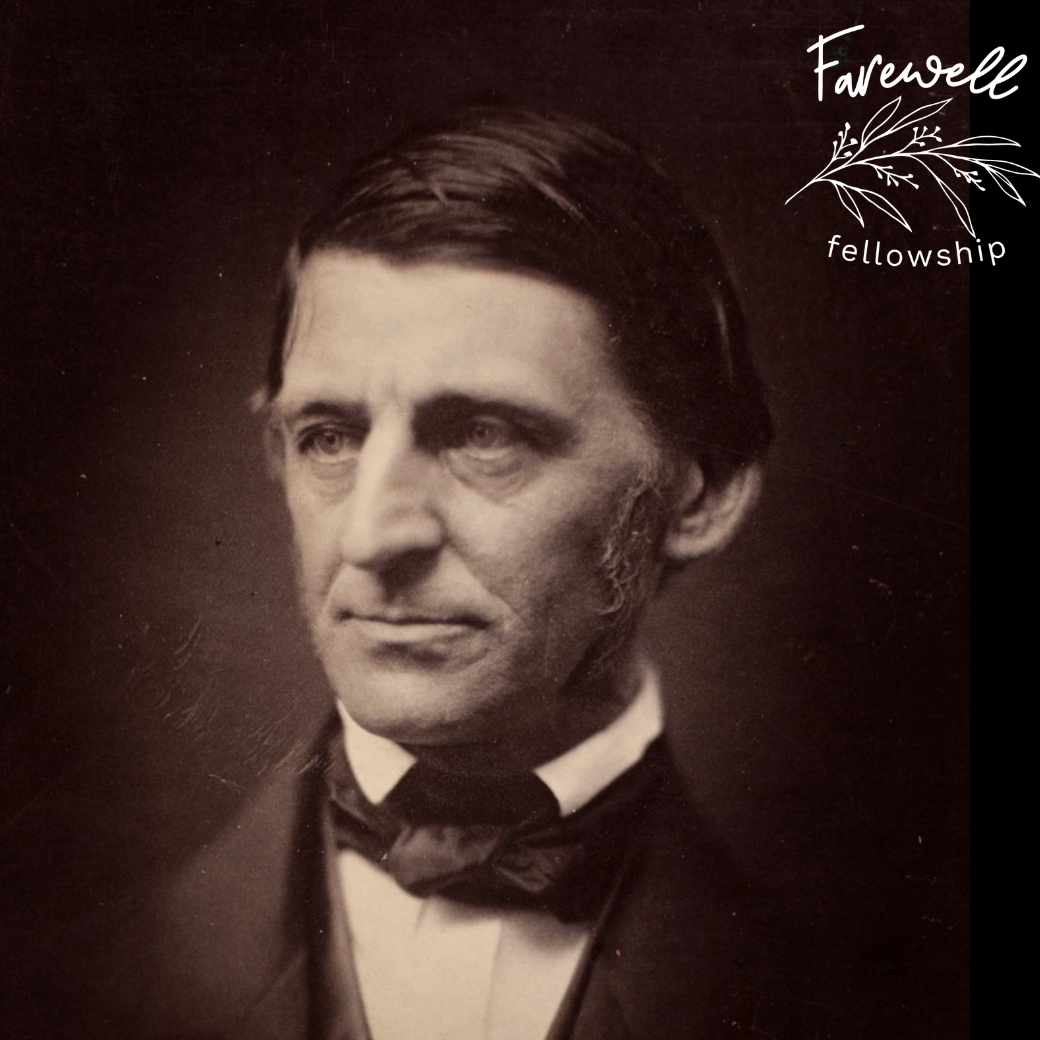
Ralph Waldo Emerson opened the coffins of both his late wife and his dead child.
To modern Americans, this feels almost unthinkable. We hide death behind hospital curtains, embalming fluid, cosmetics, euphemisms, and polished wood. We spend fortunes resisting age and decay, treating mortality as a failure rather than an inevitability. But nineteenth-century Americans inhabited a different landscape of death entirely. In their world, illness was intimate, and mourning was public. Children died with terrifying frequency, and corpses remained in the home. Grief was not hidden from view but woven into daily life, religion, philosophy, and art.
And few American writers stared more directly into the abyss than Ralph Waldo Emerson.
Today, Emerson is remembered primarily as the sage of Transcendentalism, the author of Nature and the celebrated essay Self-Reliance, works that exalted individualism, spirituality, and humanity’s relationship to the divine world. Yet beneath the philosopher’s polished prose lived a man repeatedly haunted by death. His journals, poems, and personal rituals reveal not only profound grief, but an almost gothic intimacy with the dead.
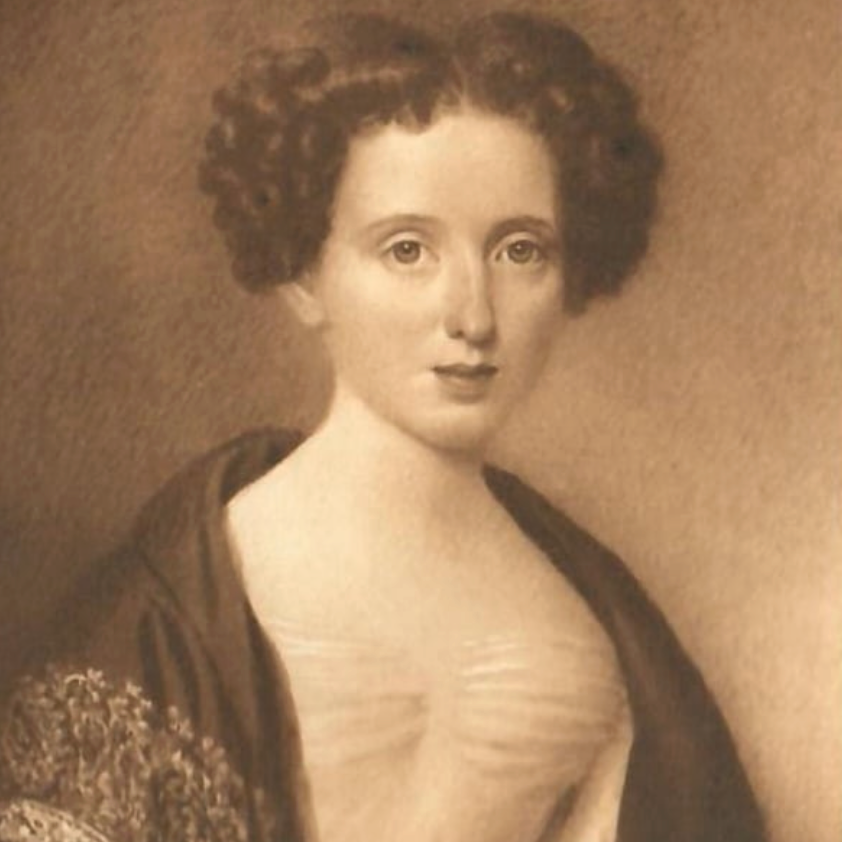
Ellen Tucker Emerson, from a miniature painted in 1829, artist unknown. [Source: The Journals of Ralph Waldo Emerson (Boston: Houghton Mifflin, 1909)]
At twenty-four years old, Emerson, a young pastor, fell deeply in love with the beautiful young poet, Ellen Louisa Tucker. She was already dying when they met. Tuberculosis (then called consumption) had settled into her body long before their marriage. The disease, romanticized throughout the nineteenth century for its languid beauty and slow wasting, gave many young writers and artists an eerie awareness of mortality. Ellen’s own poetry reflects this spectral consciousness:
“I am the grave’s, its seal is set upon me.”
Even in her private letters, death appears not as a terror but as an approaching companion. Writing to Emerson, she reflected:
“Few, let them love ever so ardently and purely, have the happiness to lie down in the earth together…”
Their marriage lasted less than two years. Ellen died in 1831 at the age of twenty. Her last words were "I have not forgot the peace and joy".
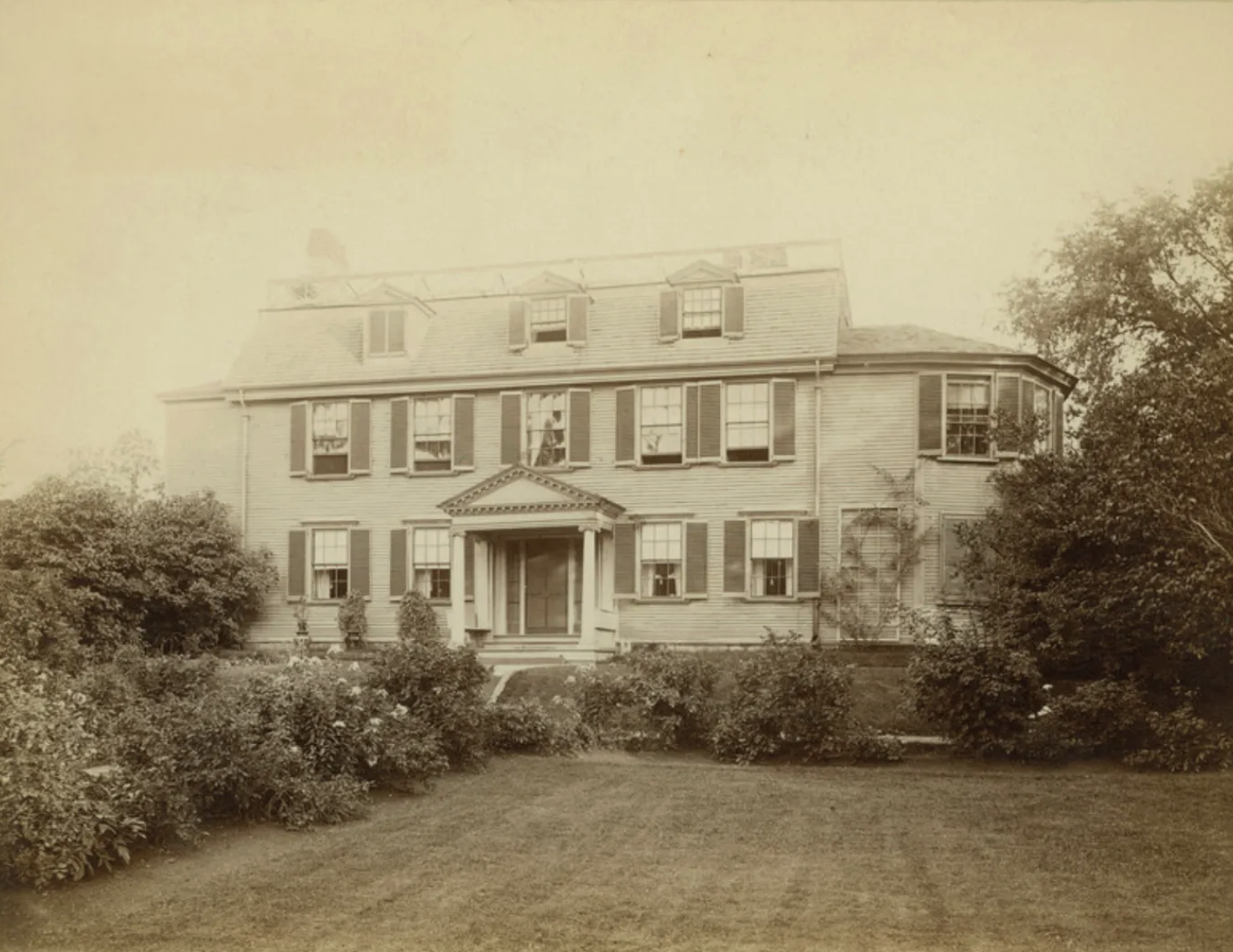
One albumen print of the Auchmuty House in Roxbury, Massachusetts. The photographer is unknown.
At the time of her death, America’s modern cemeteries did not yet exist. Before the rise of the nation’s great landscaped cemeteries, many families buried their dead on private property, churchyards, or family estates. Ellen was originally buried on the grounds of Auchmuty House, her family home in Roxbury. Death remained close to domestic life then: intimate, visible, and woven into the landscape of everyday existence.
Emerson did not recover from her death so much as reorganize his life around it.
After her burial, he walked five miles every day from Boston to visit her grave. He continued writing to Ellen in his journals as though their conversation had never ended. Grief, for Emerson, was not separation but suspended presence; the dead remained nearby, inhabiting memory with almost physical force.
Then, on March 29, 1832, Emerson performed the act that still unsettles biographers nearly two centuries later. In a sparse journal entry devoid of explanation or apology, he wrote:
“I visited Ellen’s tomb & opened the coffin.”
Nothing more: no account of what he saw, no theological meditation, no justification. Just the stark record of a widower pulling back the barrier between the living and the dead.
The moment feels almost impossibly modern in its psychological complexity. Was it disbelief? Longing? Obsession? A desperate attempt to confirm the reality of loss? Or was it simply the final intimacy available to a grieving husband in an era far more familiar with the physicality of death than our own?
In the decades following Ellen’s death, America’s burial culture transformed. Rural cemeteries such as Mount Auburn in Cambridge and Sleepy Hollow in Concord became places not merely for the disposal of the dead but for contemplation, pilgrimage, and romantic mourning. Americans increasingly aestheticized grief, turning cemeteries into gardens of memory. Ellen herself was eventually moved from her family’s property and reinterred at Mount Auburn Cemetery in 1878, becoming part of this new American landscape of mourning.
Emerson’s own life continued to be shaped by death’s repeated intrusions. After resigning from the ministry and traveling through Europe, he emerged as one of America’s most important intellectual figures. His 1836 book Nature became foundational to the Transcendalist movement, arguing that divinity could be found directly through communion with nature rather than institutional religion.
He remarried in 1835 to Lidian Jackson Emerson. Their first child, a daughter born the following year, was named Ellen, a quiet memorial to his dead wife that lingered within the household for the rest of his life. His second child, Waldo (called Wallie), was born in 1837.
In 1842, Wallie died of scarlet fever at just five years old. The loss shattered Emerson.
Friends noted a visible change in him afterward, a grief that never fully lifted. His poem “Threnody,” written in memory of Waldo, remains one of the most devastating elegies in American literature. The title itself means a lament for the dead.
Throughout the poem, Emerson struggles to reconcile philosophical acceptance with paternal agony. His transcendental ideals collapse against the unbearable reality of losing a child:
“The eager fate which carried thee
Took the largest part of me.”
Elsewhere, he writes:
“For this losing is true dying.”
The line feels startlingly direct coming from Emerson, whose public reputation often emphasizes serenity and abstraction. But “Threnody” is not abstract. It is raw, bewildered, and painfully human. Emerson attempts to frame death within nature’s eternal cycles, yet grief continually interrupts philosophy.
He writes:
“Not mine — I never called thee mine,
But Nature’s heir…”
And yet the poem repeatedly betrays the impossibility of such detachment. Wallie was not merely “Nature’s heir.” He was Emerson’s beloved son.
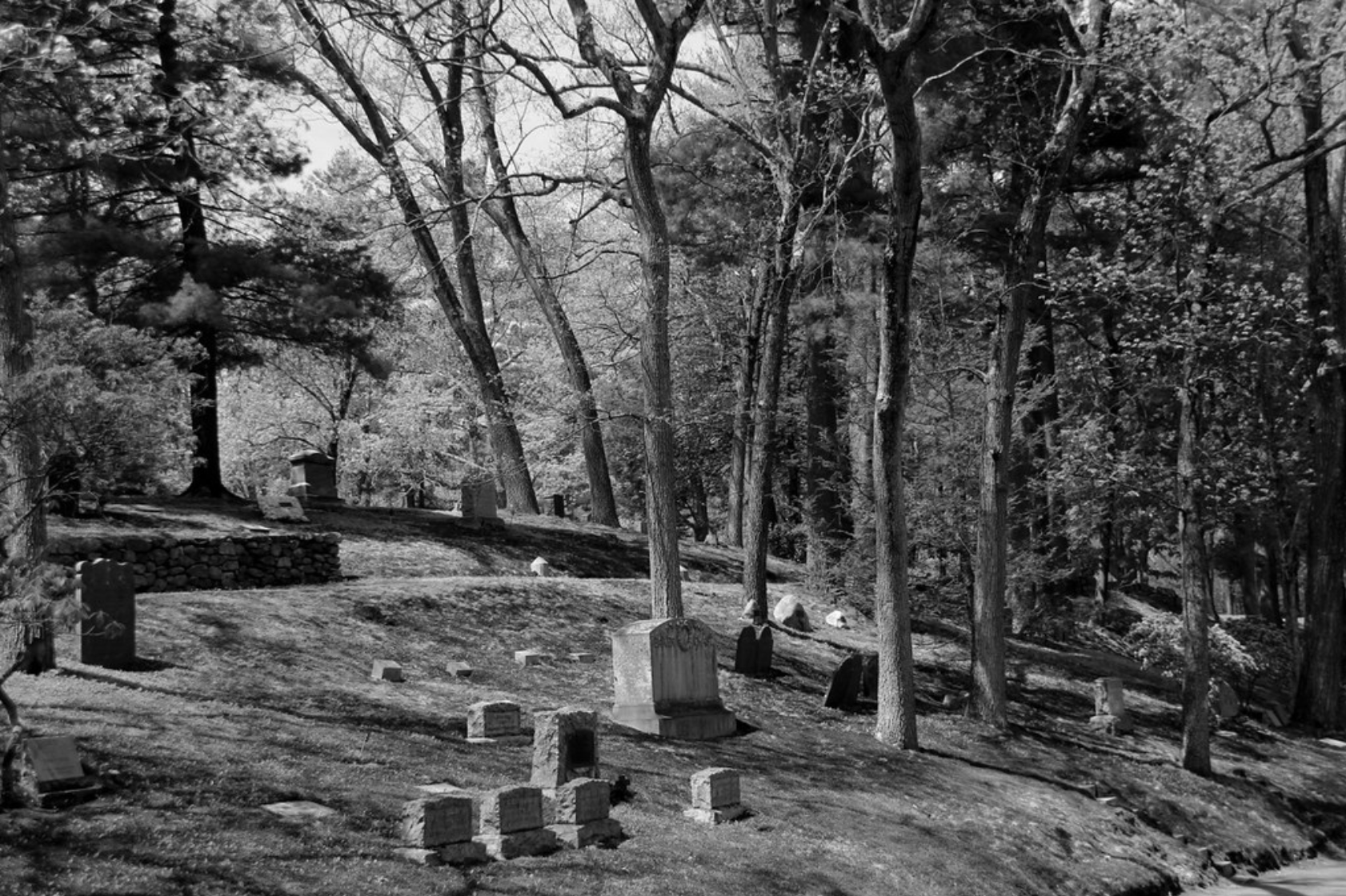
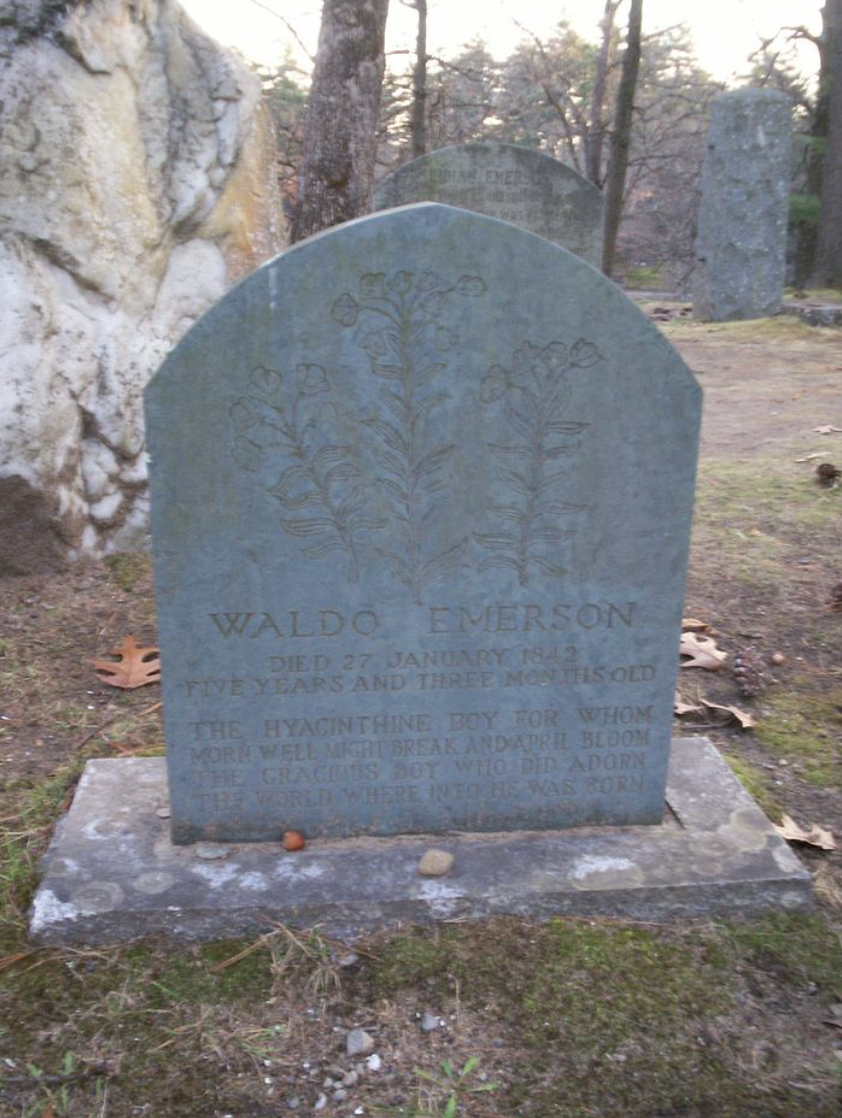
Sleepy Hollow Cemetery, Concord, MA, May 8, 2015
Years later, when Sleepy Hollow Cemetery opened in Concord, Emerson had the remains of both his mother and Waldo moved there. During the relocation, fifteen years after the boy’s death, Emerson again opened a coffin, his son’s this time.
Once more, he never recorded what he saw.
That silence may be the most haunting detail of all.
Emerson spent his life searching for evidence that the soul transcended death, that spirit survived bodily decay, that nature itself formed a bridge between worlds. Yet in these strange moments, standing over the opened coffins of those he loved most, philosophy disappears. What remains is something older, more primitive, and deeply human: the desire to look one final time.
Perhaps this is why Emerson’s grief writing still resonates more than 150 years later. Beneath the celebrated philosopher was a man who could not stop mourning.
The inscription Emerson chose for Waldo’s gravestone at Sleepy Hollow Cemetery captures both tenderness and devastation:
“The hyacinthine boy, for whom
Morn well might break and April bloom, —
The gracious boy, who did adorn
The world whereinto he was born.”
The lines are beautiful, but also deeply tragic. Emerson did not merely write about death. He lived beside it, walked with it, opened its coffin lids, and spent the remainder of his life trying to understand what remained after love survives the body.
Jade Adgate is a death doula, educator, and advocate. Through her work at Farewell Fellowship, Farewell Education, and Farewell Library, she guides others in exploring mortality and cultivating understanding, reflection, wonder, and care around life and death.