
Compassion Without Carrying

One of the things I didn’t fully understand when I began to practice my calling into death work was how much of the work would continue after I left the room. I would drive home after sitting with a client and find myself replaying everything. I would think through the conversation, the moments of silence, the questions I asked, the things I noticed, and the things I wondered if I had missed. My mind would search for the perfect response, the perfect support, the perfect way I could have shown up.
It came from a good place, a place of care. When you are invited into some of the most tender moments of another person’s life, it is natural to want to honor that trust well. But I eventually noticed something: my desire to serve could easily turn into carrying. And carrying everything is not sustainable.
If I wanted to continue this work with an open heart, I needed to learn how to be present with someone’s experience without absorbing it as my own. I needed practices that allowed me to enter the work intentionally, hold space fully, and then release what was not mine to keep. That is where my energy hygiene practices began.
When people hear the phrase “energy hygiene,” it can sometimes sound complicated or overly mystical. It might bring to mind elaborate rituals or practices that feel inaccessible. But the more I think about it, the more I realize we are already people of ritual.
Most of us have small routines woven throughout our days. We make our coffee in the same way and maybe reach for the same favorite mug every morning. We have a familiar order to our skincare routine. We know the rhythm of how we get ready for the day, how we prepare our daily meals, how we settle our homes at night before bed.
These things are not random; they create transitions. They tell our bodies and our minds, “This is where we are now.”
So I started asking myself: what if we brought that same level of intention to the way we care for our own energy?
What if energy hygiene was not something complicated we had to learn, but simply the practice of taking the ordinary things we already do and bringing awareness to them?
I believe the most sustainable rituals are not the ones that require us to become someone else. They are the ones that help us return to ourselves. The purpose of energy hygiene is not to create distance from the people we serve, but to create enough space within ourselves to remain present, compassionate, and grounded.
The rituals that have become part of my practice are simple, but they help me move through the natural rhythm of this work: entering with intention, staying rooted while I hold space, and releasing what was never mine to carry.
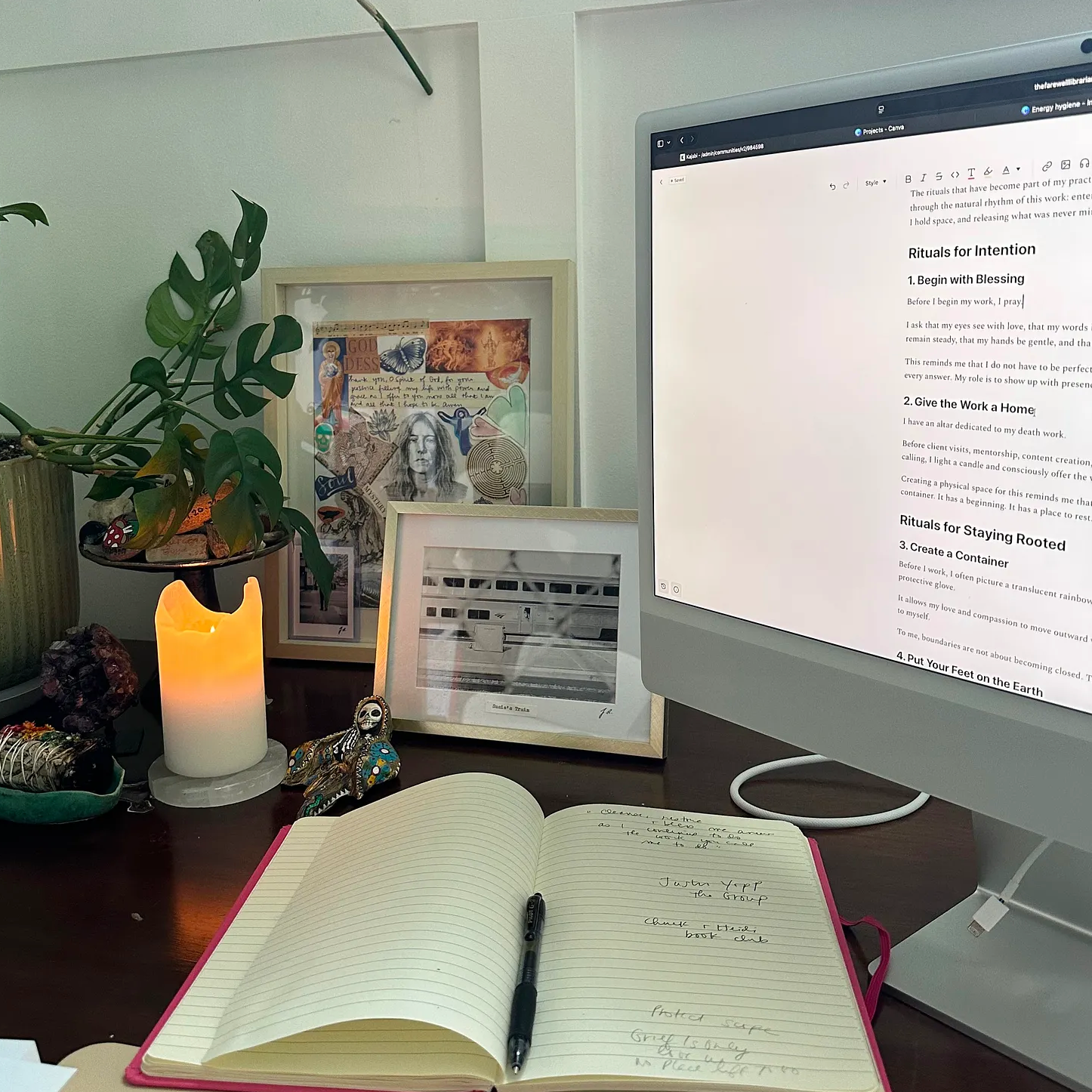
Rituals for Intention
1. Begin with Blessing
Before I begin my work, I pray.
I ask that my eyes see with love, that my words be helpful and true, that my intuition remain steady, that my hands be gentle, and that my feet be sure of the next step.
I do this before I visit a client, engage in a mentorship session, or even create content. All of these many facets comprise my deathwork and I treat each with sacredness and reverence and set intention for the work I am called to do.
This reminds me that I do not have to be perfect to serve well. I do not need to have every answer. My role is to show up with presence, humility, and compassion.
2. Give the Work a Home
I have an altar dedicated to my death work.
Before client visits, mentorship, content creation, or any work connected to this calling, I light a candle and consciously offer the work.
Creating a physical space for this reminds me that this work is sacred, but it also has a container. It has a beginning. It has a place to rest. It also has a place for me to leave my perfectionism, people-pleasing, over-responsibility, and tendency to be ever harder on myself. I’m not called to do death work perfectly. I’m called to serve.
Rituals for Staying Rooted
3. Create a Container
Before I work, I often picture a translucent rainbow of light surrounding me like a protective glove. This rainbow glove allows my love and compassion to move outward while helping me stay connected to myself.
When my children were young, they often felt too sensitive for the world. They’d lose sight of themselves and absorb the emotions of others. I found basic zip-up meditations to practice with them in the mornings before school. For my daughter, we’d step into our shimmering protective gowns and zip them up the back. This allowed our love to shine out but nothing could penetrate the protective princess gown. For my son, we’d put on invisibility cloaks like Harry Potter’s, pulling them tight around even our faces so nothing poked out. Though invisible, we knew that we were containing our energy so others could bounce right off.
In my deathwork, I use the same idea. To become invited into the most intimate and tender moments of people’s lives, to care so deeply for their bodies and spirits as they approach death, to have intimate phone calls in the middle of the night, are all to invite entanglement. To me, boundaries are not about becoming closed. They are about remaining whole. Without my container, my work is not sustainable because I over function and over care and just cannot continue to be of service without deep retreat and restoration first. Creating a container is a protective boundary that keeps my work sustainable.
4. Put Your Feet on the Earth
After intense experiences, I return to the earth whenever I can. Sunshine is lovely, but rain is powerful too.
Last weekend, I hosted a community gathering at a local funeral home. As we moved through the prep room and crematory, we talked deeply about the work and our service within in. The following day, I woke up certain I needed a hike even though a thunderstorm was moving in. Deep on the trails, the sky broke open and we were in the middle of a deluge.
The weather reminds me that everything passes through. Storms move. Seasons change. Energy shifts. I can witness what is moving around me without losing my own roots. And when I do lose my steady footing, the Earth will always restore me.
Rituals for Transition
5. Wash Your Hands
Between visits, after Zoom calls, or after difficult conversations, I wash my hands. It seems simple, but our bodies understand ritual.
Can we find a moment of mindfulness an presence for ourselves to reset as we wash? Can we smell the soap, feel the warm water in our own hands, give this small moment of care to ourselves? As the water washes away and down the drain, can we release what we just held?
This small act creates a transition point. It tells me: that moment is complete, and I am moving consciously into what comes next.
6. Call Your Energy Home
Sometimes I notice myself replaying someone’s story or carrying their experience long after the moment has ended. When that happens, I pause and ask: “What am I carrying that isn’t mine?”
Then I gently release the connection and call my attention, love, and energy back to myself. Not because I care less. Because caring and carrying are not the same thing.
My favorite practice for this is to cut the invisible cords that bind you to another. I picture little scissors and cords of light connecting me to the person on my mind. Sometimes I find myself wanting to believe that allowing these cords to exist is care. But I have to remind myself of the follow up, who decided the care is all mine to give? That’s usually the helper inside me wanting to come to the rescue.
As I cut the cords of connection, I wish the person well. I call in the spirits that guide my deathwork and release control and attachment to them. And then, I invite my energy to come back home.
Rituals for Release
7. Create a Closing Ritual
After a client visit, I come home, light a candle, and write everything down. Yes, the practical things that I want to remember the next time I see them: the observations, emotions, and how I want to follow-up. Of course, the things I need to remember. But also, the things I need to release. I let myself dump.
Once it is on the page, my mind no longer has to keep holding it. I bless the work, blow out the candle, and leave it there in the journal at the altar. The work has somewhere to rest.
8. The Full Body Shake
Throughout the day, I ask myself: “What am I carrying that belongs to someone else?”
As the mom of teenage daughters, I’m often carrying quite a bit that isn’t mine. This tiny moment of awareness helps me notice when I have taken on more than I need to. It gives me the opportunity to return what is not mine, while still honoring the love that brought me there in the first place.
To return into myself, I like to shake. Just full body convulsions, sometimes with loud music. The idea here is to trust my body to be able to move things through it. And sometimes I need the energy of music to relax into it and let my mind rest too.
In conclusion
Over time, I have realized that energy hygiene is not about becoming untouchable. It is also not about building walls between myself and the people I serve. It isn’t about caring less, feeling less, or stepping away from the tenderness of this work.
It is about creating a relationship with my own energy that allows me to keep showing up.
Because the truth is, the people who are drawn to caregiving often have very open hearts. We notice. We feel. We witness. We want to help. But a heart that is always giving also needs a place to return.
These rituals are my way of returning.
They remind me that I can sit beside someone in grief without taking their grief home as my own. I can witness suffering without believing I have to carry it. I can offer love freely while still remaining rooted in myself.
And this is not only for death doulas. It is for caregivers, nurses, healers, helpers, parents, sensitive souls, and anyone who has ever found themselves replaying a conversation days later or carrying someone else’s emotions long after the moment has passed.
Compassion does not require carrying.
We can walk beside someone through the storm without forgetting that we are still standing on our own ground. Or at least we can commit to trying, every single day anew.
Jade Adgate is a death doula, educator, and advocate. Through her work at Farewell Fellowship, Farewell Education, and Farewell Library, she guides others in exploring mortality and cultivating understanding, reflection, wonder and care around life and death.