
What “Vigil” Gets Right About Dying and Where I Wanted More
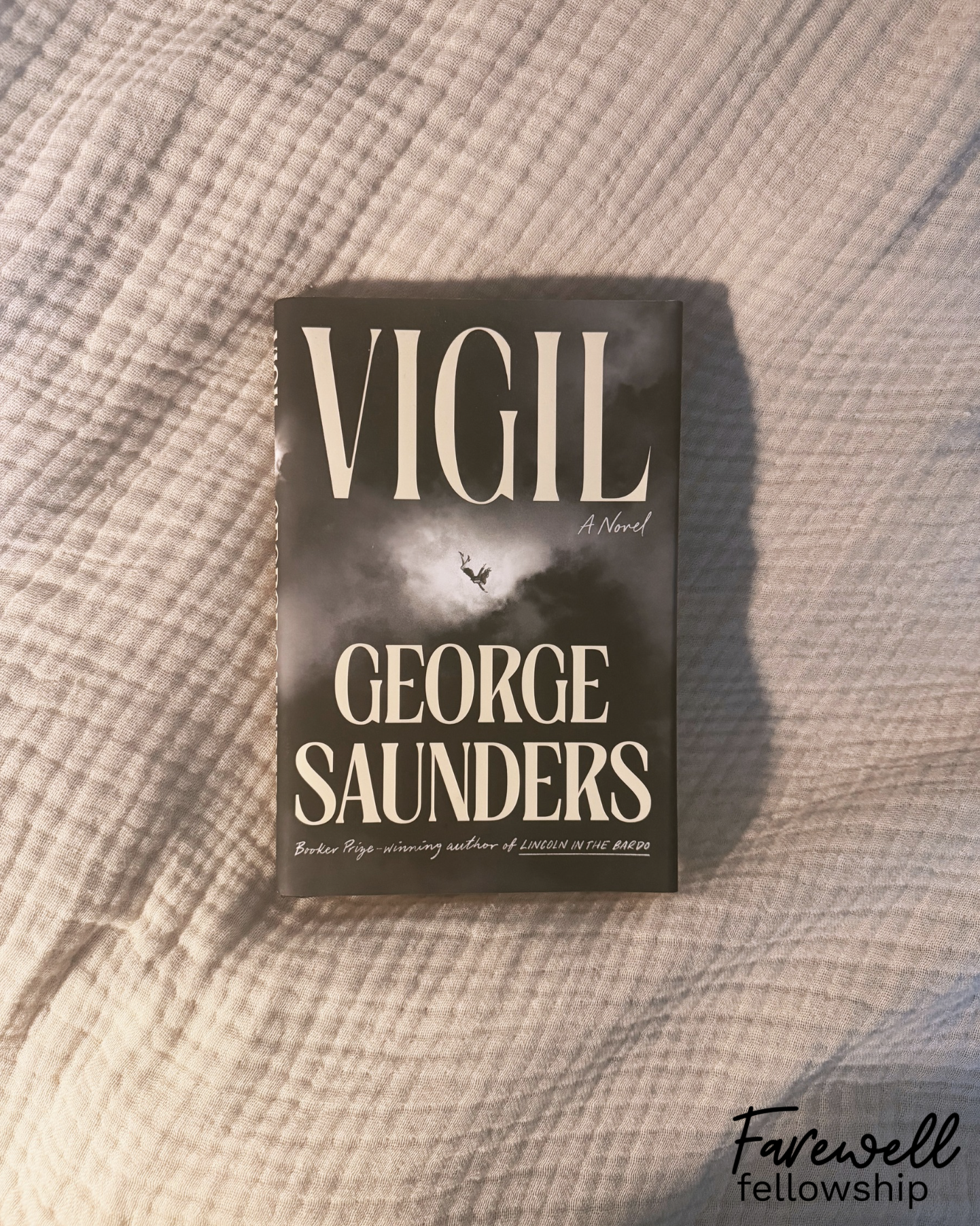
George Saunders is one of my top five living writers, so I was always going to read Vigil, and there is so much here that I wanted to love. The premise alone should have been enough to make this one of my favorite books of the year.
Jill “Doll” Blaine is essentially a dead death doula. She has been sent to accompany oil tycoon K.J. Boone through his dying process, offering comfort and helping him navigate the strange territory between life and death. As an actual death doula, I was immediately in.
Saunders returns us to the bardo he explored so beautifully in Lincoln in the Bardo, but this time we enter it alongside someone who is actively dying. The boundary between living and dead is porous. Consciousness doesn't simply disappear because the body has begun to fail. The dying person is still participating in something, even when those around him may no longer be able to see or understand it. I love this idea.
I've spent enough time around dying people to be comfortable admitting how much we don't know about what happens to consciousness near death. There are experiences at the bedside that are easy to explain medically, others that are harder to explain, and plenty that don't particularly need explaining at all. I don't need Saunders's bardo to be literally true to find something true in it. The idea that dying might be its own landscape, that the person is traveling somewhere while the rest of us are sitting beside the bed, feels familiar to anyone who has spent enough time there.
And I love that Saunders gives Doll a distinct role within that landscape: she doesn't come to cure Boone. She can't stop what is happening. Her work is the same as those of us who are living death doula’s, simply accompaniment. Through every stage of the dying process and the experience Boone has in each, Doll stays. I find this idea, of having a dead doula doula in spirit form to companion the liminal space, fascinating.
Does dying make us better?
The other idea in Vigil that fascinated me is Saunders's refusal to make death automatically transformative. Boone is an oil tycoon who reads at times like a Trump figure: extraordinarily wealthy, defensive, dismissive of criticism, and remarkably capable of minimizing the harm caused by his choices. And then he starts dying.
There is a familiar cultural story about what happens next, likely what you’d expect to happen: the dying person sees clearly for the first time as they realize what really mattered. They reconcile with their children. They apologize. They confess. They finally understand that money and power weren't the point. Death becomes a kind of moral solvent in the redemption story, dissolving all the bullshit until only truth remains. Except I don't think dying necessarily works that way.
Sometimes people soften. Sometimes they reconcile. Sometimes they experience enormous clarity. And most often, people die exactly as they lived. The person who controlled everyone may continue trying to control the room. The person who avoided difficult conversations may continue to dismiss, distract, and shut down. The person who used humor to survive may still be making jokes. The person who has spent a lifetime constructing a particular story about themselves may hold onto that story until the very end. Sometimes our patterns become more visible rather than less and Saunders understands this. Boone does not arrive at the threshold and suddenly become someone else; he remains Boone. If anything, he becomes more steadfastly himself.
I found that far more interesting than a redemption story.
What if we're haunted by how we lived?
Saunders also makes the consequences of Boone's life impossible for him to completely escape. There is something almost medieval about this idea: that at the end, the things we've done follow us into the room. Not necessarily as punishment but maybe simply as consequence. What if dying strips away our ability to keep moving fast enough not to look behind us? What if eventually we have to sit still with the life we've made? That's an idea I could have followed Saunders into for another hundred pages.
Unfortunately, Vigil kept wandering away from it.
The question I wanted the book to ask
This is where the book ultimately lost me. There are too many side quests and not enough depth in the places I most wanted Saunders to stay. And most importantly, I never felt an ounce of compassion for Boone. In fact, I'm more capable of finding sympathy for Donald Trump than I was for this fictional man, which feels like a problem; not because Boone needs to be likable (or any dying person, in fact), he absolutely doesn't. But because Saunders has constructed an extraordinary moral situation: a compassionate presence has been sent to accompany someone who may not seem particularly deserving of compassion. And that raises a much harder question than whether Boone will finally recognize the harm he's caused:
What does it mean to accompany someone toward death when you believe they have caused tremendous harm?
That is the book I desperately wanted to read. Does everyone deserve tenderness at the end of life? Especially as headlines of the failed execution of Christa Pike dominates the news coverage, this question seems timely and necessary. And to take it even a step further, from the death doula perspective: does accompaniment require compassion? What if the dying person never apologizes? What if they remain defensive? What if their version of their life is fundamentally incompatible with the experiences of the people they hurt? Can we comfort someone without absolving them? Can we witness someone's humanity without pretending they used that humanity particularly well? And what responsibility does the person sitting beside the bed have to any of it?
These aren't theoretical questions in end of life work. Death doulas don't only accompany people whose values align with ours. Nurses don't only care for people they like. Hospice workers don't conduct moral background checks before entering someone's home. Eventually, if you do this work long enough, you encounter the uncomfortable truth that dignity at the end of life cannot depend entirely on whether someone has lived the kind of life you approve of. And that is difficult.
There is a difference between believing that every human being deserves care and actually sitting beside a particular human being whose choices you find reprehensible. Vigil gets incredibly close to that tension. But sadly, it sidesteps it.
Accompaniment without absolution
Maybe that's what I wanted most from Doll. I wanted to understand what it costs to remain beside Boone. Because in my work, accompaniment isn't the same thing as forgiveness and my presence isn't absolution. Providing compassionate care at end-of-life isn't an endorsement of the life someone lived. There is something profound in the possibility that we can refuse to look away from the harm someone caused and still refuse to abandon them while they're dying. Those two truths can exist beside each other: you did harm and I will sit with you while you die.
That, to me, is much more interesting than redemption and infinitely more difficult.
Following Saunders back into the bardo
Ultimately, Vigil contains many ideas I love without becoming a book I loved.
I love Saunders's continued exploration of the bardo. I love his willingness to imagine dying as an active state of consciousness rather than simply the moment before someone disappears from the story. I love the suggestion that we may remain stubbornly ourselves until the end. I love the possibility that the consequences of our lives might accompany us across the threshold. And, obviously, I love that the central act of the novel is someone showing up to accompany a dying person.
Doll may be dead, but Saunders represents something essential about death doula work surprisingly well: we don't make the crossing for someone. We don't necessarily make sense of it. We certainly don't get to determine what happens on the other side. Mostly, we accompany. We witness. We stay. That’s all and that’s enough.
There is a version of Vigil buried inside Vigil that explores what it means to offer that kind of presence to someone who is difficult to love, difficult to forgive, and perhaps entirely unwilling to change. I think I would have loved that book. This one kept wandering away from it.
But George Saunders is George Saunders, and I'll keep following him into the bardo anyway, trusting that the next journey will contemplate exactly these questions.
Jade Adgate is a death doula, educator, and advocate. Through her work at Farewell Fellowship, Farewell Education, and Farewell Library, she guides others in exploring mortality and cultivating understanding, reflection, wonder and care around life and death.