
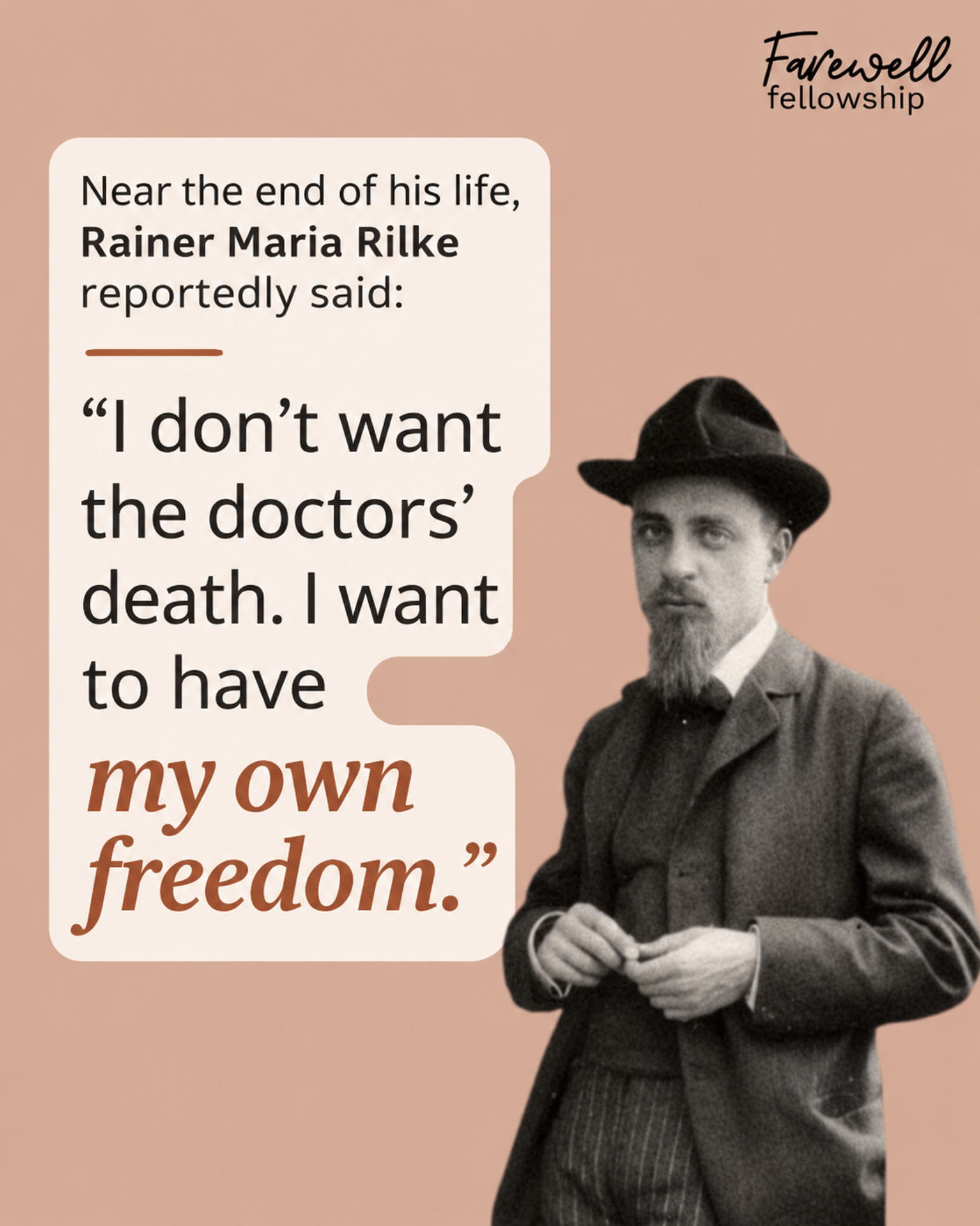
In 1926, as Rainer Maria Rilke approached the end of his life, the friend caring him recalled him saying “Help me to my own death. I don't want the doctors' death. I want my freedom.” More than twenty years earlier, Rilke had written a poem asking that each person be granted their own death. I've been thinking about that idea: each our own death.
“O Lord, give each person his own personal death.
A thing that moves out of the same life he lived,
In which he had love, and intelligence, and trouble.”
In end-of-life care, we talk a lot about helping people have a "good death." But I wonder how often we stop to ask whose definition of good we're using. Is it the death that makes the family most comfortable? The one that aligns with medical recommendations? The peaceful, beautiful, well-planned death we sometimes idealize in the end-of-life community? Or is it the death that belongs to the person experiencing it?
A person might choose aggressive treatment until their last breath. They might refuse intervention. They might want to die at home, or feel safest surrounded by medical professionals. None of those choices inherently makes a death more or less dignified but they may feel more true to the person.
Maybe the trick isn't to have a "good death" but to have our own freedom through death too?